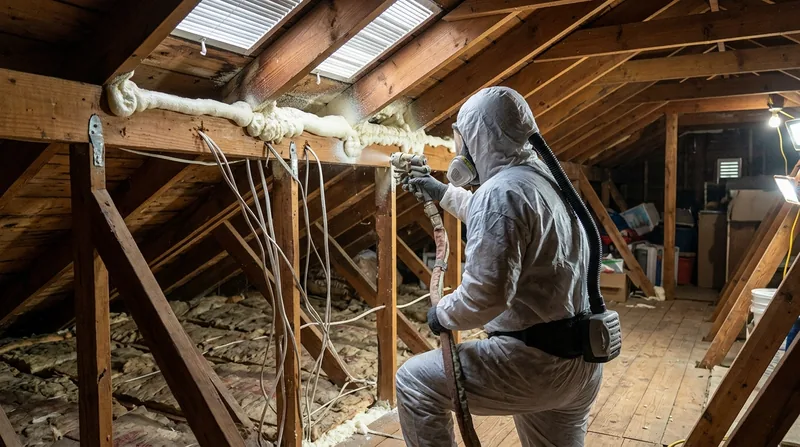




Air sealing in Asheville stops conditioned air from leaking through gaps at top plates, rim joists, and attic penetrations in homes across Buncombe County and the surrounding mountain towns. Older homes in Montford, Kenilworth, and West Asheville sit over damp crawl spaces on sloped lots, with wall cavities under-insulated and attics bleeding heat and cooling through unsealed framing. Mid-century ranches throughout the county carry flattened batt insulation in vented attics, while mountain homes near Black Mountain, Weaverville, and Arden face rim and band joists exposed to winter cold snaps. In climate zone 4A, mixed-humid, your energy bills track two things above all: how much outside air leaks through old framing year-round, and how much moisture sits trapped under the house. We seal those gaps with spray foam, stop the stack effect through cold winters, and reduce the drafts that cost you money every heating and cooling season. See our attic spray foam insulation service for the full picture of how sealing ties into your whole attic strategy.
Why Air Sealing Matters in Older Asheville Homes
Air leaks are the silent drain on energy bills in Asheville's housing stock. A home built before 1980 with original framing, drywall, and plaster rarely has tight seals where the top plate meets the exterior wall, where electrical penetrations punch through the attic floor, or where rim joists sit exposed to outdoor air. In winter, warm air inside your home rises and escapes through these gaps, forcing your heating system to work harder. In summer, cold air conditioning leaks out the same way. The stack effect in a two-story home with an open attic is especially aggressive on these sloped mountain lots, where the pressure difference between indoors and outdoors is constant.
- Air leaks at the top plate let conditioned air rise and escape from living spaces into the attic year-round.
- Electrical boxes, HVAC chases, and plumbing vents punch unsealed holes in the attic floor and rim joists.
- Rim and band joists on homes in Weaverville, Black Mountain, and Fletcher are exposed to winter wind and cold snaps that drive air infiltration into basements and crawl spaces.
- Damp crawl spaces under Montford and West Asheville homes pull humid air upward through wall cavities and into living spaces, raising cooling load and moisture risk.
- Sealed attic work (closed cell foam or spray foam retrofit) requires air sealing as the first step, or conditioned air will still leak out through the old framing below.
Stopping these leaks is the single biggest credibility differentiator between a spray foam contractor and a fiberglass crew, because fiberglass never seals air at all.
Key info: North Carolina building code requires that any spray foam insulation installation meet the thermal and ignition barrier rules in force at your address. Permits and contractor registration vary from city to city across Greater Asheville. Always verify what applies at your specific address with your local building department before work starts. See the North Carolina Department of Insurance for contractor and building code guidance.
How We Seal Air Leaks: Step by Step in Asheville
Air sealing is not a single product or technique; it is a discipline of finding every gap, measuring it, and filling it with the right material at the right thickness. We start with a walkthrough of your attic, crawl space, or rim joist to identify where air is actually moving. We look for gaps at top plates, around electrical boxes, at HVAC penetrations, where rim joists meet the rim band, and anywhere the original framing has settled or shrunk. Once we know the scope, we seal those gaps with spray foam, caulk, or gaskets depending on the size and location. Spray foam is the best choice for large gaps and for areas that will later be covered by insulation. Smaller gaps get caulked or sealed with backer rod. The goal is zero air movement through the thermal envelope, not zero visible foam.
- We inspect your attic floor, rim joists, and crawl space to locate air leaks and measure gap sizes.
- We seal top plates with spray foam, working from the attic side to stop warm air from rising into the rim space.
- We seal electrical boxes, HVAC chases, and plumbing vents with foam or caulk to stop air movement around penetrations.
- We seal rim and band joists with closed cell spray foam to block outside air from entering basements and crawl spaces.
- We document the work with photographs and notes so you know exactly what was sealed and where.
Every air seal job is custom because every home's gaps are in different places and different sizes.
Example: A 1970s ranch in Fairview with an open attic and a damp crawl space might have gaps at the top plate where the original drywall has settled, electrical boxes poking through the attic floor without sealant, and a rim joist that is completely exposed to outside air. We would seal the top plate with foam, caulk the electrical boxes from the attic side, and spray the entire rim joist with closed cell foam to stop air and moisture infiltration. The homeowner sees lower heating and cooling bills and a drier crawl space.
| Approach | Description | Best for |
|---|---|---|
| Spray Foam Sealing | Open cell or closed cell foam injected into gaps at top plates, rim joists, and large penetrations. Expands to fill voids and hardens into an air and moisture barrier. | Large gaps, rim joists, attic top plates, areas that will be insulated. Closed cell for moisture-prone crawl spaces and rim joists. |
| Caulk and Backer Rod | Silicone or acrylic caulk applied to small cracks and gaps, with foam backer rod inserted first for gaps wider than 1/2 inch. Hardens in 24 to 48 hours. | Small gaps around electrical boxes, plumbing penetrations, and drywall seams. Areas visible after work is done. |
| Gasket and Tape Sealing | Adhesive-backed foam gaskets or specialized air sealing tape applied to electrical outlets, junction boxes, and other penetrations. Quick, clean, and no cure time. | Electrical outlets and boxes in attics and rim spaces. Vapor-permeable gaskets for mixed-humid climates like Asheville. |
| Closed Cell Spray Foam Rim Joist | High-density closed cell foam sprayed to 1.5 to 2 inches on rim and band joists. Seals air and provides continuous R-value insulation. Moisture-resistant. | Exposed rim joists in Weaverville, Black Mountain, and other mountain locations. Stops winter infiltration and summer cooling loss. |
Air Sealing Cost in Asheville: What to Expect
Air sealing cost depends on how many gaps you have, how large they are, and where they sit. A small attic top plate seal in a single-story ranch might start at $650. A full attic air seal with top plates, electrical penetrations, HVAC chases, and rim joist work on a two-story home in Montford or Kenilworth typically runs $1,200 to $2,500. Crawl space rim joist sealing on a home with 100 linear feet of exposed rim band might run $1,500 to $2,000. The biggest factor that moves cost upward is the size of the area and the number of penetrations. Access matters too: if your attic is a crawl space with low headroom and lots of obstructions, the work takes longer and costs more. If you have standing water or wet insulation in your crawl space, we fix the moisture problem first or we walk away, because foam will not stick to wet surfaces and will trap moisture underneath.
Getting 2 to 3 written estimates is the smart move. Each estimate should specify what gaps will be sealed, what material will be used, and what the R-value or thickness will be where applicable. If an estimate has no detail on what is actually being sealed, that is a red flag. See our full pricing page for guidance on what different scopes cost in the Asheville area.
Air Sealing Near Me: What to Look for When Hiring a Spray Foam Contractor in Asheville
Finding a qualified air sealing contractor near Asheville starts with verifying their insurance and asking the right questions about their process. Call any contractor you are considering and ask them to describe in detail what they will seal, what material they will use, and what the finished work will look like. A professional will have a clear answer. Ask whether they use mechanical ventilation during the cure period and what the re-entry window is (it should be 24 to 48 hours for spray foam). Ask for references from recent jobs in your area, Asheville, Biltmore Forest, Weaverville, or Fletcher, and call at least two of them. Ask whether they pull permits if your local building department requires them, and whether they are familiar with attic ventilation code and the thermal barrier rules in force at your address. If you have an HOA, check whether exterior work on your home or crawl space access requires architectural approval before work starts.
- Verify the contractor is fully insured and ask to see a current certificate of insurance naming your address.
- Get written estimates from at least two contractors that specify what will be sealed, the material, and the expected outcome.
- Ask the contractor whether they are familiar with your local building code and whether permits are required at your address.
- Call references and ask about the quality of the seal, whether the crew was professional, and whether the homeowner would hire them again.
- Check whether your HOA has rules about insulation or crawl space access work before you book.
Contact us for a free written estimate at (828) 519-0053 or through our contact page. We will walk your attic or crawl space, explain what we find, and give you a clear price with no obligation to book.
Air Sealing in Asheville: Pricing Guide
| Service | Price | Details |
|---|---|---|
| Small attic top plate seal | Starting at $650 | Single-story ranch, top plate only, minimal penetrations, 500 to 800 sq ft attic floor area |
| Full attic air seal with penetrations | $1,200 to $2,500 | Top plates, electrical boxes, HVAC chases, plumbing vents, two-story home, 1,200 to 1,800 sq ft attic floor |
| Rim joist and band joist sealing | $1,500 to $2,000 | 100 linear feet of exposed rim band, closed cell foam, 1.5 to 2 inch thickness, basement or crawl space |
| Crawl space air seal with rim and sill | $2,000 to $3,500 | Rim joist, band joist, sill plate, and top plate of rim wall, multiple penetrations, damp environment, closed cell material |
| Travel and estimate | Included and free | No separate mileage fee in Asheville and surrounding areas, response within 24 hours, no obligation to book |
Indicative pricing, the exact cost depends on square footage, finish, and site access. Free personalized estimate within 24h at (828) 519-0053.


