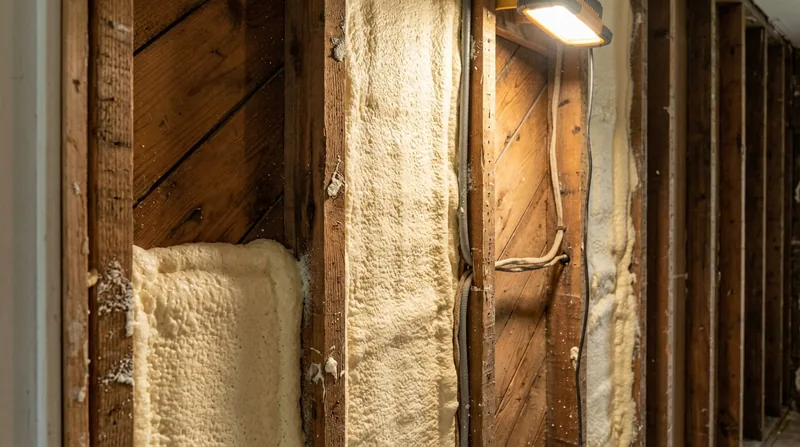




Open cell spray foam insulation in Asheville fills wall cavities and attic decks in the mixed-humid climate zone 4A that dominates Buncombe County and the surrounding mountains. Asheville's older homes in Montford, Kenilworth, and West Asheville sit over damp crawl spaces and under vented attics where humidity shifts with the season, pushing moisture inward during humid summers and reversing direction in winter cold snaps. Open cell foam expands to seal gaps around framing without the weight of closed cell, making it the right choice for sound dampening and moderate R-value retrofit work on homes where the wall cavity or attic deck is not exposed to bulk water or extreme temperature swings. We remove failed insulation, seal air leaks, and install open cell foam to the thickness and density your attic or wall cavity needs. Our work carries a workmanship warranty, and every estimate includes R-value and thickness specifications so you know what you are paying for.
Why Open Cell Spray Foam Matters in Asheville's Mixed-Humid Climate
Asheville sits in a climate zone where the direction of vapor flow reverses with the season. Humid summers push moisture inward through attic vents and wall cavities, while winter cold snaps reverse that drive and pull moisture back out. Older homes across Montford, West Asheville, and the surrounding mountain towns were built with vented attics and under-insulated wall cavities that leak conditioned air through top plates, rim joists, and around electrical penetrations. Open cell spray foam seals those air gaps without trapping moisture against the framing, making it the natural answer for attic retrofit and wall cavity filling in this region.
- Open cell foam expands to fill irregular gaps around framing, electrical boxes, and ductwork that fiberglass batts leave uncovered.
- It adheres to wood, metal, and concrete, creating an air seal that cuts drafts without adding structural weight to older framing.
- Open cell is permeable to moisture, allowing water vapor to pass through rather than trapping it against the rim joist or band joist in winter.
- The material is cost-effective for attic retrofit and provides sound dampening in addition to thermal resistance.
- Installation is faster than hand-laying batts, and the cure time allows re-entry within 24 to 48 hours with proper mechanical ventilation during application.
For homeowners in Asheville, Fletcher, and Weaverville facing energy bills driven by air leakage and damp crawl spaces, open cell spray foam in the attic or rim joist is often the first retrofit that shows measurable return.
Local example: A 1970s ranch in West Asheville with a vented attic and original fiberglass batts settled and compressed over 50 years. Summer humidity and winter cold snaps created condensation on the roof deck. Open cell spray foam sealed the air leaks at the top plate and rim joist, allowing the attic to breathe while cutting the thermal bypass that was costing the owner 20 to 30 percent of their heating and cooling load.
For more details on how spray foam works in attics, see our guide to attic spray foam insulation in Asheville. If you are considering a sealed attic or roof deck instead, closed cell spray foam is the choice when you need higher R-value and vapor barrier properties.
How We Install Open Cell Spray Foam: Step by Step in Asheville
Open cell spray foam installation starts with a site inspection to identify air leaks, moisture sources, and the substrate condition. We measure the cavity depth, confirm there is no active water intrusion or condensation, and determine the thickness and density needed to meet code and your energy goals. We set up mechanical ventilation to manage fumes during cure, protect surrounding areas with tarps and masking, and apply the foam in controlled passes to avoid over-packing, which creates stress on the framing and reduces the R-value per inch.
- We inspect the attic, crawl space, or wall cavity to confirm the substrate is dry and free of contamination.
- We establish mechanical ventilation and set up containment to protect HVAC ducts, electrical wiring, and finished spaces below.
- We apply open cell foam to the specified thickness in multiple passes, allowing each pass to set before the next layer goes down.
- We install thermal and ignition barriers if required by code at your address (typically a 15-minute barrier over open cell in attics).
- We allow 24 to 48 hours cure time with mechanical ventilation running before the space is re-entered or occupied.
- We provide a written record of the R-value, thickness, and coverage area so you can verify the work against the estimate.
The entire process for a typical attic retrofit in Asheville takes one to two days depending on square footage and cavity depth.
Asheville example: A 1,400 sq ft attic in Biltmore Forest with 6 to 8 inches of compressed fiberglass over a vented roof deck. We removed the old insulation, sealed air leaks at the rim joist and top plate with open cell foam, and brought the attic to R-38 with 5.5 inches of new open cell. The homeowner was able to enter the attic the next morning with minimal odor, and their summer cooling load dropped by 18 percent within the first month.
If your home needs air sealing beyond the insulation itself, our air sealing service focuses on the gaps and penetrations that fiberglass cannot reach. For wall cavities and retrofit insulation in pre-1980 homes, see our wall and injection foam service.
Open Cell Spray Foam Insulation Methods and Applications in Asheville
| Approach | Description | Best for |
|---|---|---|
| Attic retrofit with open cell | Remove old insulation, seal rim joist and top plate, apply 5 to 7 inches of open cell to R-38 or R-49 depending on cavity depth and existing frame height. | Vented attics in older homes across Montford, West Asheville, and mid-Buncombe where air leakage through the top plate is the dominant energy loss. |
| Wall cavity fill | Inject open cell foam into existing wall cavities through small access holes drilled in the exterior or interior, filling voids left by settled batts or missing insulation. | Pre-1980 homes in Asheville, Fletcher, and Black Mountain with 2x4 or 2x6 framing and no interior insulation or severely compressed batts. |
| Rim and band joist sealing | Spray open cell foam over the rim joist and band board where the house frame sits on the foundation, sealing air gaps and thermal bridges. | Homes on sloped lots in Weaverville, Arden, and the mountain towns where winter cold and ice dams are driven by heat loss through the rim joist. |
| Garage ceiling and wall retrofit | Apply open cell foam to the underside of the garage roof deck or to interior garage walls to reduce heat loss and sound transmission to living spaces above. | Attached garages in Asheville and Biltmore Forest where the garage is unheated and sits directly below bedrooms or living areas. |
| Crawl space perimeter sealing | Spray open cell foam on the rim joist and band board in crawl spaces to reduce air infiltration and moisture movement into the floor framing above. | Damp crawl spaces under older homes in Montford and West Asheville where moisture is driven upward through the rim joist in summer and winter. |
Open Cell Spray Foam Insulation Cost in Asheville: What to Expect
Open cell spray foam in Asheville starts at approximately $0.55 per board foot, with most attic retrofit jobs in the 1,200 to 2,000 sq ft range landing between $2,500 and $6,000 depending on cavity depth, the amount of air sealing required, and whether old insulation removal is included. A board foot is the material as it leaves the gun, measured by thickness and area on site. The price moves up if the attic has active moisture, if the rim joist or band board requires extensive air sealing, or if the old insulation is contaminated and requires professional removal. Wall cavity filling and rim joist work typically run $1,500 to $3,500 for a single-story home in Asheville or Weaverville. Garage ceiling retrofit ranges from $800 to $2,200 depending on the square footage and whether the work includes framing inspection or thermal barrier installation.
The most reliable way to understand cost for your home is to request a free written estimate that specifies the R-value, thickness in inches, and total board feet of material. We provide that detail on every estimate so you can compare quotes apples-to-apples. For a full pricing breakdown and examples by job type, see our pricing page.
Factors that move cost up include removal of existing insulation (add $0.50 to $1.50 per sq ft for attic removal and disposal), air sealing of rim joists and penetrations beyond the primary cavity (add $200 to $600), and thermal or ignition barrier installation if required by your local building code (add $0.15 to $0.35 per sq ft). If you are comparing estimates, verify that each one includes the thickness and R-value target, the cost of removal if applicable, and the workmanship warranty terms.
What to Look for When Hiring an Open Cell Spray Foam Contractor Near Me in Asheville
Hiring a spray foam insulation contractor in Asheville or the surrounding mountain towns requires the same diligence you would apply to any trade. Verify that the contractor is fully insured and can provide a certificate of insurance naming your address as the job site. Ask for references from homeowners in Asheville, Biltmore Forest, or Weaverville whose work was completed in the last two years, and call at least two to confirm that the job was finished on time, the odor cleared within 48 hours, and the contractor was reachable if questions came up after completion. Get written estimates from at least two contractors that specify the R-value, thickness in inches, the cost of removal if included, and any thermal or ignition barrier work. Do not accept an estimate with no R-value or thickness specification, or one that promises immediate re-entry without mechanical ventilation during cure. Confirm with your local building department or HOA whether permits are required at your address and whether the work triggers inspection or architectural approval.
- Ask to see proof of current insurance and request a copy for your records before work begins.
- Request at least two local references and call them to confirm the timeline, odor management, and post-job support.
- Get a written estimate that names the R-value, thickness, and board feet of material so you can verify the work when it is complete.
- Confirm that mechanical ventilation will run during application and that re-entry will not be promised before 24 to 48 hours with proper cure time.
- Check with your local building department about permit requirements and thermal barrier rules that apply at your address.
- Verify that the contractor will walk away if the substrate is wet, contaminated, or if there is active water intrusion, rather than spray over the problem.
For a free estimate and to verify our insurance and references, contact us at (828) 519-0053. We serve Asheville, Biltmore Forest, Woodfin, Weaverville, Fairview, Swannanoa, Fletcher, Black Mountain, and the surrounding mountain towns in Buncombe, Henderson, Rutherford, Jackson, Haywood, and McDowell counties.
Open Cell Spray Foam Insulation in Asheville: Pricing Guide
| Service | Price | Details |
|---|---|---|
| Open cell spray foam attic retrofit | Starting at $0.55/board ft | Includes material, labor, and mechanical ventilation during cure; final cost depends on cavity depth and square footage |
| Wall cavity filling and injection foam | Starting at $1,500 | Retrofit insulation for pre-1980 homes; cost varies with wall height, cavity width, and number of access points required |
| Rim joist and band board sealing | Starting at $800 | Perimeter air sealing in crawl spaces and basements; pricing depends on linear footage and whether existing insulation must be removed first |
| Insulation removal and disposal | Starting at $0.50/sq ft | Professional removal of failed, settled, or contaminated insulation; cost increases if material is damp or requires hazmat handling |
| Thermal and ignition barrier | Starting at $0.15/sq ft | Code-required fire barrier over open cell in attics; exact requirement depends on local building code at your address |
| Free written estimate | No charge | Response within 24 hours at (828) 519-0053; includes R-value, thickness, and board-foot calculation for your specific job |
Indicative pricing, the exact cost depends on square footage, finish, and site access. Free personalized estimate within 24h at (828) 519-0053.


