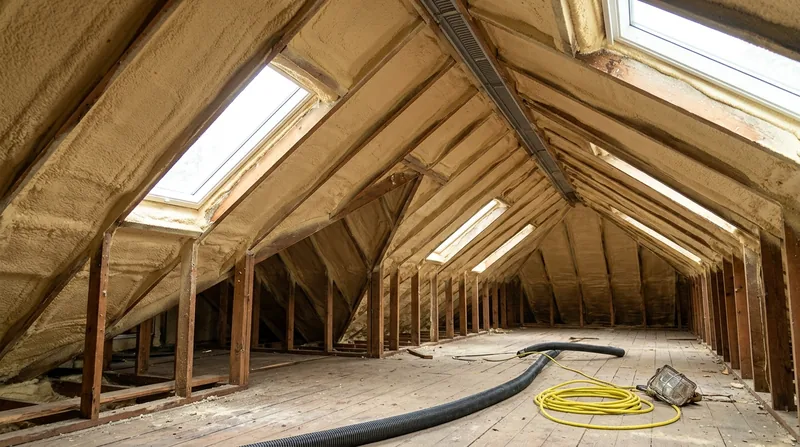




Attic spray foam insulation in Asheville stops the heat gain and winter drafts that plague mountain homes in this mixed-humid climate. Asheville sits in IECC zone 4A, where humid summers push moisture inward through attic vents and cold winters reverse that drive, creating a two-season assault on energy efficiency. Homes across Montford, Kenilworth, West Asheville and the surrounding mountain counties lose conditioned air through top plates, roof penetrations and rim joists faster than any other building envelope failure. We spray foam insulation across rafters and roof decks to seal those leaks, control moisture flow, and stabilize attic temperature year-round. Whether your attic is a vented space with flattened batts or a sealed roof deck needing retrofit, the work is precise and measurable. Call us at (828) 519-0053 for a written estimate with R-value and thickness specifications, or visit our homepage to learn how spray foam insulation works across our service area.
Why Attic Spray Foam Insulation Matters in Asheville's Mountain Climate
Asheville's attics face a unique challenge. Summer humidity and winter cold create opposite vapor-drive directions, meaning moisture can move inward in July and outward in January. Older homes in Montford and Kenilworth, built over crawl spaces on sloped lots, have attics that leak air through original framing and poorly sealed penetrations. Mid-century ranches across Buncombe County carry flattened fiberglass batt insulation in vented attics, which settles, loses R-value, and allows convective air movement around the fibers. Mountain homes near Black Mountain, Weaverville and Arden sit exposed to winter cold snaps and ice, and any gap in the attic envelope compounds heating costs. Spray foam stops that air leakage, controls moisture direction with a vapor-permeable open cell option or a vapor-blocking closed cell option, and holds its R-value for the life of the home.
- We seal air leaks around electrical boxes, HVAC penetrations and ductwork that fiberglass cannot reach.
- Spray foam adheres to rafters and roof decks, preventing convection and settling that degrades batt insulation over time.
- Closed cell foam creates a moisture barrier, critical for sealed attics in Asheville's humid-cold cycle.
- Open cell foam allows drying, preferred for vented attics where vapor management and cost matter equally.
- We remove failed or contaminated insulation before spraying, ensuring the substrate is clean and ready to bond.
Getting the insulation right in your attic is the single biggest lever on energy bills in this region.
Key info: Asheville building code and the North Carolina energy code govern attic ventilation, ignition barriers and thermal barrier requirements. Your local building department (Asheville, Biltmore Forest, Weaverville, Fletcher or whichever city applies) has the final say on whether your attic is sealed or vented, and what thickness and density of foam is permitted. Your local building department can tell you what applies at your address. Verify any contractor's credentials and ask for references before signing.
For more details on how closed cell and open cell foam differ, see our guide to closed cell spray foam insulation.
How We Install Attic Spray Foam Insulation in Asheville Homes
The process begins with a site visit and a detailed written estimate that specifies R-value, foam thickness, and the square footage to be covered. We inspect the attic for moisture, contamination, roof leaks or structural damage that must be addressed before foam is applied. If old insulation is in place, we remove it and dispose of it responsibly. We then set up mechanical ventilation to manage off-gassing during the cure period, mix the foam to the manufacturer's exact ratio and drum temperature, and spray in controlled passes to achieve the specified thickness without over-application. The foam expands and cures over 24 to 48 hours, after which we remove temporary ventilation and the space is ready for re-entry.
- We inspect the attic substrate, roof deck and framing for moisture, leaks or active water intrusion before any foam is sprayed.
- Contaminated or wet attics are not sprayed; we address the moisture source first or refer you to the appropriate specialist.
- We set up mechanical ventilation during application and cure to manage fumes and ensure safe re-entry within 24 to 48 hours.
- We apply foam in multiple passes at the specified thickness per pass, never overshooting in a single application.
- Once cured, the foam is air-sealed, insulating and stable for decades with no settling or off-gassing.
The result is an attic that holds temperature, resists moisture infiltration and stops the drafts that make heating and cooling work harder.
Local example: A 1970s ranch in West Asheville with a vented attic and 4 inches of settled fiberglass over 1,200 square feet typically gets 5 to 6 inches of open cell foam sprayed across the roof deck, achieving R-28 to R-30 and sealing the top plates and rim joists where air leaks out around the exterior walls. A sealed attic in newer construction near Weaverville might call for 5 to 6 inches of closed cell foam to manage moisture and achieve R-30 to R-35, with all penetrations and gaps sealed before foam is applied.
For more on the air sealing that goes hand-in-hand with spray foam, visit our air sealing service page.
Spray Foam Methods for Asheville Attics
| Approach | Description | Best for |
|---|---|---|
| Open Cell Spray Foam | Low-density foam (0.5 to 1.5 lb/cu ft) that expands to fill cavities and allows water vapor to pass through. Achieves R-3.5 to R-4 per inch. | Vented attics in Asheville where cost and vapor permeability are priorities; sound dampening in garage attics. |
| Closed Cell Spray Foam | High-density foam (2 to 3 lb/cu ft) with closed cells that block water vapor and air movement. Achieves R-6 to R-7 per inch and provides structural rigidity. | Sealed attics and roof decks where moisture control and higher R-value per inch are critical; mountain homes exposed to winter cold and humidity swings. |
| Attic Air Sealing Before Foam | Mechanical sealing of top plates, penetrations, ductwork and rim joists with foam or sealant before insulation is applied across the whole attic. | All attic jobs, especially retrofit of older homes in Montford, West Asheville and Kenilworth where air leakage is the primary energy loss. |
| Insulation Removal and Replacement | Complete removal of old fiberglass, cellulose or failed foam, disposal, attic cleanup, and installation of new spray foam insulation in a single project. | Mid-century ranches and homes with degraded batt insulation; retrofit of attics with previous foam failures or moisture damage. |
Attic Spray Foam Insulation Cost in Asheville: What to Expect
Spray foam insulation is priced per board foot on site after measurement and inspection. A typical attic job in Asheville starts at $1.50 per square foot for open cell foam in a straightforward vented attic, and rises to $2.50 to $3.50 per square foot for closed cell foam or jobs requiring significant air sealing, substrate prep or removal of existing insulation. The final cost depends on attic size, foam type (open cell vs. closed cell), desired R-value, the condition of the existing substrate, and whether insulation removal is included. A 1,200 square foot attic with 5 inches of open cell foam and light air sealing typically runs $1,800 to $2,400. A sealed roof deck with 6 inches of closed cell foam and comprehensive air sealing can range from $3,600 to $5,400 for the same square footage.
Travel is included in Asheville and surrounding areas with no separate mileage charge. We provide a free written estimate within 24 hours of your call. The estimate specifies R-value, thickness, board feet, and labor, so you can compare apples to apples with other contractors. Get 2 to 3 estimates before deciding; the cheapest bid often signals a contractor cutting corners on ventilation during cure, mixing ratio, or thickness specification. Our pricing page covers the full range of our services and includes guidance on what drives costs up or down.
Call (828) 519-0053 to schedule your free estimate today.
Attic Spray Foam Insulation Near Me: What Asheville Homeowners Should Know Before Hiring
Hiring a spray foam contractor is a significant decision because the work is invisible once complete and the consequences of poor installation (off-gassing, inadequate ventilation during cure, wrong foam density or thickness) can linger for months. Here is what to verify before you sign a contract. First, confirm that the contractor is fully insured and ask for a certificate of insurance naming your address. Second, ask for a written estimate that specifies R-value, thickness in inches, board feet, and labor cost; any estimate without these details is a red flag. Third, check references from recent jobs in your area (Asheville, Weaverville, Fletcher, Black Mountain). Fourth, ask about the cure timeline, mechanical ventilation during application, and the re-entry window; honest contractors say 24 to 48 hours and explain why. Fifth, confirm that permits are being pulled if required by your city and building department. Sixth, if you have an HOA or architectural review requirement, verify that spray foam work on the exterior of metal buildings or sealed attics is approved before work begins.
- Request a written estimate with R-value, thickness, square footage and labor itemized; verbal quotes and per-board-foot pricing without thickness specs invite disputes later.
- Ask the contractor to walk you through the removal, substrate prep and ventilation plan before foam is sprayed.
- Verify that the contractor has liability insurance and ask for proof; "fully insured" should be backed by a current certificate.
- Check that your city permits are in place or will be pulled before work begins; Asheville, Biltmore Forest and Weaverville each have their own requirements.
- Get references from homeowners in your neighborhood and call them to ask about smell, timeline and whether the contractor was reachable after the job.
- Avoid contractors who promise immediate re-entry, offer prices far below market, or cannot provide insurance verification; these are markers of rig-and-run operations.
The best protection is a local contractor with a local address, a track record in your community, and the willingness to explain the work in writing before the first dollar is spent.
Ready to move forward? Contact us at our contact page or call (828) 519-0053 for your free, no-obligation estimate.
Attic Spray Foam Insulation in Asheville: Pricing Guide
| Service | Price | Details |
|---|---|---|
| Open Cell Spray Foam, Vented Attic | Starting at $1.50/sq ft | 4 to 6 inches of open cell foam, R-3.5 to R-4 per inch, air sealing around penetrations and top plates included |
| Closed Cell Spray Foam, Sealed Attic or Roof Deck | Starting at $2.50/sq ft | 5 to 6 inches of closed cell foam, R-6 to R-7 per inch, vapor barrier, all air sealing and substrate prep included |
| Insulation Removal and Replacement | On estimate | Removal, disposal and haul-away of old fiberglass or failed foam, attic cleanup, new spray foam installation; scope and condition determine final price |
| Air Sealing Before Foam Application | Included | Mechanical sealing of top plates, electrical penetrations, ductwork and rim joists as part of the spray foam installation package |
| Travel and Site Visit | Included | No separate mileage charge or call-out fee within Asheville and surrounding service areas; free written estimate within 24 hours |
Indicative pricing, the exact cost depends on square footage, finish, and site access. Free personalized estimate within 24h at (828) 519-0053.


