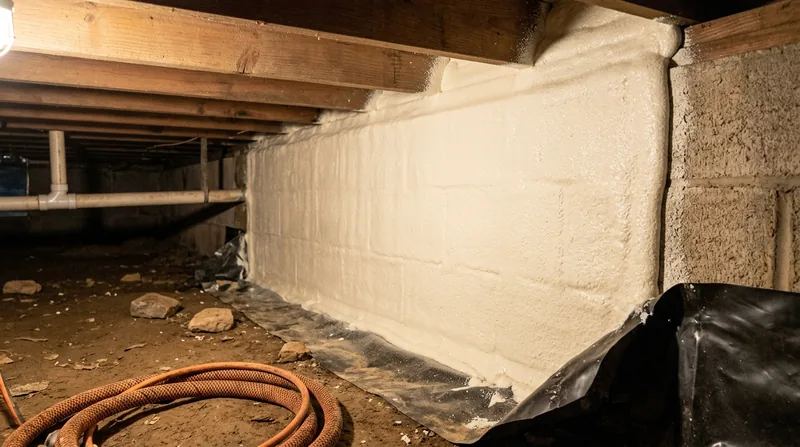




Closed cell spray foam insulation in Asheville stops moisture and air leaks where they matter most: rim joists, crawl space walls, and foundation areas across Buncombe County. Asheville sits in IECC climate zone 4A, mixed-humid, where humid summers push moisture inward through walls and cold mountain winters reverse that drive. Older homes in Montford, Kenilworth, and West Asheville sit over damp crawl spaces on sloped lots, with original wall cavities under-insulated and rim joists exposed to winter cold snaps and ice. Mid-century ranches across the county carry flattened batt insulation in vented attics while mountain homes near Black Mountain, Weaverville, and Arden deal with condensation on steel framing and band joists. Closed cell foam seals and insulates in one pass, giving you a vapor barrier that works both directions. We use it to block drafts and moisture in older framing where fiberglass fails, and to control condensation on metal buildings across Henderson, Rutherford, Jackson, Haywood, and McDowell counties. Get a written estimate with R-value and thickness specs at (828) 519-0053, or learn more about how attic spray foam insulation complements foundation work.
Why Closed Cell Spray Foam Matters in Asheville's Damp Mountain Climate
Asheville's humid summers and cold winters create a two-direction moisture problem. Warm, moist air from outside pushes inward in summer; cold interior air reverses the flow in winter. Fiberglass batts and blown-in cellulose cannot stop that bidirectional vapor drive, so moisture gets trapped in walls and crawl spaces, feeding rot and mold. Closed cell foam cures into a vapor barrier that slows moisture in both directions, keeping water vapor from condensing inside the wall cavity or on cold metal framing. On rim joists and band joists of older homes, closed cell foam also seals the air gaps that let outside air and cold pour into the basement or crawl space.
- Closed cell foam expands to fill gaps and cracks in rim joists, blocking infiltration of outside air and moisture.
- The foam cures into a vapor barrier, slowing moisture movement in both directions across the foundation boundary.
- On metal buildings and barndominiums, closed cell foam prevents condensation from forming on cold steel, protecting insulation and framing from rust and water damage.
- In crawl spaces with high humidity, closed cell foam on foundation walls reduces the moisture load that would otherwise settle into the space below your home.
These four factors are why closed cell foam is the right choice for Asheville's foundation and rim joist work, where moisture control is the primary failure mode.
Key info: Asheville homes in West Asheville and Montford sit over crawl spaces that stay damp year-round. Closed cell foam on the foundation walls and band joists cuts that moisture load and stops the cold drafts that make heating bills climb in January and February.
For more context on how air sealing pairs with closed cell foam, see our guide to air sealing in Asheville. North Carolina's building code and your local building department govern attic ventilation and thermal barrier requirements, so always verify what applies at your address before work begins.
How We Install Closed Cell Spray Foam Insulation in Asheville Homes
Closed cell foam installation starts with a site walkthrough to identify where moisture and air leaks are costing you energy and comfort. We measure the square footage, assess access and substrate condition, and recommend the thickness and R-value that match your use case. If a crawl space or rim joist is wet, we do not spray over it; we walk away and you fix the moisture source first. Once the substrate is dry and prepped, we spray the foam in controlled passes, maintaining the manufacturer's ratio and drum temperature, then provide mechanical ventilation during the cure window to keep VOCs from building up indoors. Re-entry is typically 24 to 48 hours after cure, depending on thickness and conditions. You get a written estimate with R-value and thickness specs, not a price-per-board-foot guess.
- We walk the site and identify air leaks, moisture sources, and areas where closed cell foam will give you the best return.
- We verify that substrates are dry and sound before we spray; if moisture or contamination is present, we refer you to the right specialist and do not proceed.
- We spray in controlled passes at the correct ratio and temperature, maintaining foam quality and adhesion.
- We provide mechanical ventilation during cure and specify a 24 to 48 hour re-entry window, allowing VOCs to off-gas safely.
- We deliver a written scope with R-value, thickness in inches, and square footage so you know exactly what you paid for.
This step-by-step approach is why homeowners in Asheville and Weaverville choose us over rig-and-run crews that spray in an afternoon with no ventilation and promise immediate re-entry.
Example: A 1970s ranch in Fairview had a damp crawl space and cold rim joists. We sealed the rim joist band with 2 inches of closed cell foam (R-13), then foamed the foundation walls 4 inches high (R-26). The crawl space stayed drier, the basement stopped drafting, and heating costs dropped measurably by February.
Learn more about how crawl space spray foam insulation pairs with rim joist work to control moisture and drafts.
Closed Cell Spray Foam Approaches and Applications
| Approach | Description | Best for |
|---|---|---|
| Rim and Band Joist Sealing | Closed cell foam sprayed 2 to 4 inches thick on the rim joist and band joist perimeter to seal air gaps and block moisture infiltration. | Older homes in Asheville and Montford with drafty basements and cold floors, damp crawl spaces, and heating bills that spike in winter. |
| Crawl Space Foundation Wall Foam | Closed cell foam applied 4 to 6 inches up the foundation wall to create a vapor barrier and reduce moisture migration into the crawl space. | Damp crawl spaces under mountain homes where humidity and moisture settle year-round, especially on sloped lots in West Asheville and Weaverville. |
| Metal Building and Barndominium Condensation Control | Closed cell foam sprayed on the interior of metal roof decks and walls to prevent condensation from forming on cold steel during humid summers and cold winters. | New and retrofit metal buildings, barndominiums, and pole barns across Buncombe, Henderson, and Rutherford counties where steel framing is exposed to temperature swings. |
| Sealed Attic Roof Deck Spray | Closed cell foam sprayed 2 to 3 inches thick on the underside of roof decking to create a sealed, conditioned attic with no ventilation needed. | New construction and retrofit homes where you want to condition the attic space and eliminate hot attic temperatures in summer that drive cooling costs. |
| Wall Cavity and Injection Foam Retrofit | Closed cell foam injected into existing wall cavities through small holes to fill gaps and add R-value without demolition. | Pre-1980 wood-frame homes in Asheville, Black Mountain, and Fletcher where original cavities are under-insulated and exterior walls are cold to the touch in winter. |
Closed Cell Spray Foam Insulation Cost in Asheville: What to Expect
Closed cell spray foam typically starts at $1.20 per board foot in the Asheville area, but your final cost depends on several concrete factors. Rim joist and band joist work on a single-story ranch might run 50 to 100 board feet; a two-story home with a full basement perimeter could reach 200 to 400 board feet. Crawl space foundation wall foam is priced by linear feet of wall height and the thickness you choose (4 to 6 inches is typical). Metal building and sealed attic jobs scale with roof deck square footage and the thickness needed for your climate zone and use case. Access matters: if your rim joist is tight or your crawl space has low headroom, installation takes longer and costs more. Substrate condition also affects price; if we find wet insulation or contamination, removal and disposal add to the scope, which is why we always recommend a free, written estimate before you commit. Get two or three estimates so you can compare R-value, thickness, warranty, and the contractor's approach to ventilation and re-entry timing. See our full pricing overview for typical ranges by job type.
What to Look for When Hiring a Closed Cell Spray Foam Contractor Near Me in Asheville
Finding the right spray foam contractor near you in Asheville means verifying three things: insurance, references, and honest communication about permits and what the work actually costs. Ask any contractor you interview to confirm they are fully insured and can provide a certificate of insurance on request. Call at least two references from jobs completed in the last 12 months in Asheville or nearby towns like Weaverville, Fairview, or Black Mountain. A good estimate includes R-value, thickness in inches, square footage, and the re-entry window; if a contractor quotes you a price per board foot with no detail, walk away. Ask about their approach to ventilation during cure and how they verify substrate condition before spraying. If your home is in a historic district or an HOA, confirm that the contractor understands local architectural or master-planned restrictions on exterior work. Permitting and registration requirements vary by city, so verify what your local building department requires at your address; Asheville, Weaverville, and Fletcher each have different rules, and there is no reciprocity between them. A local contractor with a local address and local plates is your best bet for follow-up and accountability if the smell lingers or questions arise after cure. Call us at (828) 519-0053 for a free estimate, or contact us to discuss your specific project and get a written scope with no obligation.
Closed Cell Spray Foam Insulation in Asheville: Pricing Guide
| Service | Price | Details |
|---|---|---|
| Rim Joist and Band Joist Sealing | Starting at $1.20/board ft | 2 to 4 inches thick on perimeter framing; cost scales with linear feet of joist and home footprint size |
| Crawl Space Foundation Wall Foam | Starting at $1.20/board ft | 4 to 6 inches up the wall; total cost depends on linear feet of foundation and moisture condition of existing substrate |
| Metal Building and Sealed Attic Roof Deck | Starting at $1.20/board ft | 2 to 3 inches on roof decking; total cost scales with roof square footage and complexity of access and penetrations |
| Wall Cavity and Injection Foam Retrofit | Starting at $1.20/board ft | Fills existing cavities without demolition; cost depends on wall area, cavity depth, and density of injection ports needed |
| Removal of Failed or Contaminated Insulation | On estimate | If old foam or fiberglass must be removed before new spray foam is installed, scope and disposal cost require site inspection |
| Free Written Estimate | Free | Includes R-value, thickness, square footage, and re-entry window; call (828) 519-0053 for response within 24 hours |
Indicative pricing, the exact cost depends on square footage, finish, and site access. Free personalized estimate within 24h at (828) 519-0053.


