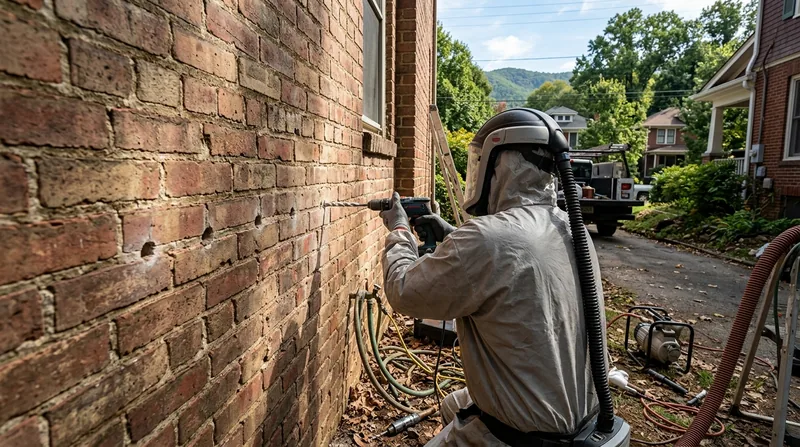




Wall & Injection Foam Insulation in Asheville fills the hollow cavities in older homes without tearing into finished walls. Montford, Kenilworth, and West Asheville sit thick with solid brick and wood frame construction from the early 1900s through the 1960s, built before fiberglass batts were standard in wall cavities. These homes leak cold air and humidity year-round because the walls were never insulated at all. Injection foam reaches into those dead cavities from the outside, sealing drafts and stopping moisture migration without opening drywall or plaster. On the sloped terrain of Buncombe County, where older homes sit over damp crawl spaces and face seasonal moisture shifts, wall insulation that stops air infiltration is often the single fastest way to cut heating and cooling bills and improve comfort. Read on to learn how this retrofit works, what it costs, and how to hire the right contractor.
Why Wall & Injection Foam Insulation Matters in Asheville's Older Housing Stock
Asheville and the surrounding Buncombe County neighborhoods were built in waves. The brick and wood frame houses of Montford and Kenilworth, many dating to 1920 through 1960, have solid exterior walls with no cavity insulation. Seasonal moisture in this mixed-humid climate drives inward in winter and outward in summer, and uninsulated walls with air leaks accelerate that movement. A home without wall insulation can lose 25 to 35 percent of its conditioned air through wall cavities and rim areas. Injection foam stops that loss without the cost and disruption of new siding or interior demolition.
- Fills hollow cavities in older brick and wood frame walls without opening finished surfaces.
- Stops air infiltration and moisture movement through wall cavities in one retrofit pass.
- Works in homes where exterior access is difficult or where interior walls are finished and occupied.
- Improves comfort in winter by eliminating cold drafts along exterior walls and in corner bedrooms.
- Reduces heating and cooling runtime, lowering monthly utility bills on homes that have never had wall insulation.
Injection foam is the practical answer for the retrofit homes that dominate Asheville's neighborhoods.
Local example: A 1950s ranch in West Asheville with original solid brick walls, no wall insulation, and single-pane windows loses heat through wall cavities and air leaks faster than through the roof. Injection foam into those walls cuts heating bills 12 to 18 percent and eliminates the cold draft that makes the living room uncomfortable in January.
For more on how air sealing complements wall insulation, see our air sealing service page. North Carolina building code and local permitting rules for spray foam vary by city, so verify what applies at your address with your building department before work begins.
How Wall & Injection Foam Insulation Works in Asheville Homes
Injection foam insulation is a retrofit technique that pumps low-pressure foam into the hollow cavities of existing walls from the exterior or interior, without removing siding, drywall, or plaster. The process takes a day or two depending on the square footage and wall configuration. Technicians drill small holes (typically 1 to 2 inches) into the wall cavity at intervals, inject the foam, allow it to cure, and patch the holes to match the existing wall. The foam expands to fill the cavity completely, sealing air leaks and creating a continuous thermal and air barrier.
- We assess the wall cavity depth, insulation status, and any existing obstructions before drilling.
- We drill access holes on a grid pattern, typically every 12 to 16 inches vertically, into the wall cavity from outside or inside depending on access and finish.
- We inject low-pressure spray foam into each hole, allowing it to expand and fill the cavity completely.
- We allow the foam to cure per manufacturer specifications, typically 24 to 48 hours before re-entry.
- We patch all access holes with matching material, caulk, or sealant to restore the wall finish.
The result is a sealed wall cavity with continuous insulation and no air pathways.
Example in Weaverville: A 1940s cottage with brick veneer over wood frame and hollow cavities gets injection foam through holes drilled on 16-inch centers from the exterior. The foam fills every void in the cavity, stops air infiltration through the wall, and the holes are patched with matching mortar. No interior walls are touched, and the homeowner stays in the house during the job.
For homes where walls are severely compromised or where cavity access is blocked, insulation removal and replacement may be the better path. We help you choose the right method for your house.
Wall & Injection Foam Methods and When to Use Each
| Approach | Description | Best for |
|---|---|---|
| Exterior injection | Holes drilled through siding or brick from outside, foam injected into the cavity, holes patched to match exterior. | Brick or clapboard walls where interior is finished and occupied, or where exterior access is easier than interior. |
| Interior injection | Holes drilled through drywall or plaster from inside, foam injected, holes patched with spackle and paint. | Homes where exterior access is difficult, or where interior walls are unfinished or in renovation. |
| Cavity-by-cavity fill | Systematic drilling and injection of each wall cavity to ensure complete fill and no voids. | Retrofit homes where the cavity structure is clear and accessible, maximizing insulation coverage. |
| Partial cavity fill with air sealing | Foam injection combined with caulking and sealing of rim areas, band joists, and wall penetrations for maximum air control. | Homes where wall cavities exist but rim and band joists are the primary air leak source. |
Each method is chosen based on your home's construction, the wall cavity layout, and your access preferences. We drill only what is necessary and patch every hole to restore the wall finish.
Wall & Injection Foam Insulation Cost in Asheville: What to Expect
Wall injection foam insulation in Asheville typically starts at $2 to $3 per square foot of wall area, depending on cavity depth, wall configuration, and access. A 1,500 square foot home with 800 linear feet of exterior wall at 8 feet high would be roughly 6,400 square feet of wall surface, though only the cavity area (typically 60 to 80 percent of that) is filled. Actual cost depends on how many holes must be drilled, whether the work is interior or exterior, the condition of the existing wall, and whether the cavity is clear or partially obstructed. Travel within Asheville and surrounding areas is included. We provide a written estimate with the square footage, injection points, and R-value target for the cavity fill before work begins.
- Cavity depth and width affect the amount of foam needed and the time to complete drilling and injection.
- Exterior versus interior access changes the drilling and patching method, which can shift labor time and material cost.
- Wall obstructions such as wiring, plumbing, or fire blocking inside the cavity may require adjustment of injection points and increase labor.
- Multiple stories and corner walls require more drilling and injection points, raising total square footage and cost.
- Existing wall damage or moisture in the cavity must be addressed before injection, which may add scope.
The best way to know your actual cost is to get a free on-site estimate. Call us at (828) 519-0053 or visit our pricing page for more detail on factors that affect the final bill. We respond within 24 hours and provide a written quote with no obligation to proceed.
What to Look for When Hiring a Wall & Injection Foam Contractor Near Me in Asheville
Hiring a spray foam contractor is a critical decision because poor installation leads to incomplete fills, moisture traps, and odor complaints that linger for months. A qualified contractor will provide a detailed estimate with R-value targets, cavity dimensions, and injection point locations before work begins. They will describe their curing process, including mechanical ventilation during cure and a 24 to 48 hour re-entry window. They will carry full insurance and be reachable after the job is done if questions arise. Get at least two estimates from contractors in Asheville and the surrounding areas, compare the scope and not just the price, and ask for references from recent wall injection jobs.
- Verify that the contractor is fully insured and can provide a certificate of insurance before work begins.
- Ask for a written estimate that includes the square footage of wall, the target R-value, cavity depth, and number of injection points.
- Request references from at least two similar wall injection jobs completed in the last 18 months, and call them to ask about odor, curing time, and comfort improvement.
- Confirm that the contractor uses mechanical ventilation during spray and cure, and that they enforce a 24 to 48 hour re-entry window before occupants return.
- Check that the contractor can explain the difference between open cell and closed cell foam, and can justify which one is right for your wall cavity.
- Ask whether the contractor handles their own drilling and patching, or whether they subcontract those tasks, and confirm that patch quality matches your wall finish.
- Confirm that the contractor can walk you through local permitting requirements with the City of Asheville or your municipality, and that they will help navigate any HOA rules if applicable.
A contractor who cannot provide a written estimate with R-value and thickness specs, or who promises immediate re-entry without curing time, is a red flag. Contact us at our contact page to discuss your wall insulation project and get a free estimate with full details.
Wall & Injection Foam Insulation in Asheville: Pricing Guide
| Service | Price | Details |
|---|---|---|
| Wall injection foam insulation | Starting at $2/sq ft | Cavity fill, drilling, injection, and patching included; price varies by cavity depth, wall configuration, and access method |
| Interior injection (drywall patching) | Starting at $2.50/sq ft | Includes drywall hole drilling, foam injection, spackle repair, and paint matching to existing wall finish |
| Exterior injection (brick or siding patching) | Starting at $2.75/sq ft | Includes exterior hole drilling, foam injection, caulk or mortar patching, and finish restoration to match existing wall |
| Complex or obstructed cavities | On estimate | Cavities with wiring, plumbing, fire blocking, or moisture require site assessment before pricing is confirmed |
| Travel | Included | No separate mileage fee within Asheville and surrounding Buncombe County service area |
| Free estimate | No charge | Written quote with cavity dimensions, R-value target, and injection points provided within 24 hours of call |
Indicative pricing, the exact cost depends on square footage, finish, and site access. Free personalized estimate within 24h at (828) 519-0053.


