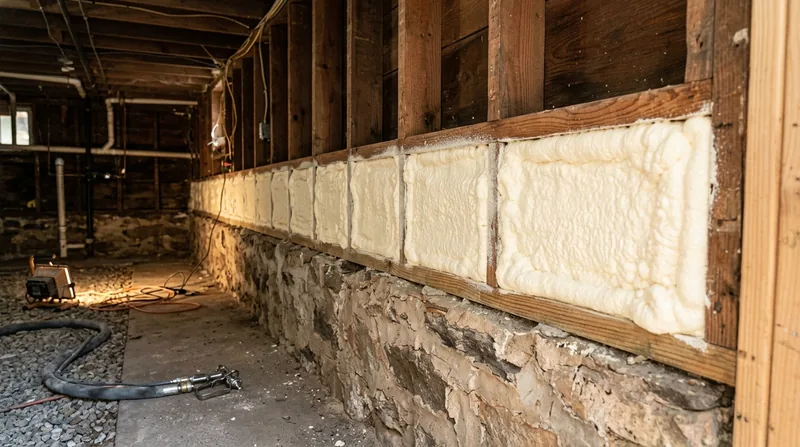




Cold floors and drafty basements in Asheville homes often trace back to one overlooked detail: the rim joist and band joist. This horizontal band of wood sits where the foundation meets the first floor framing, and in Asheville's cold mountain winters and humid summers, it becomes a thermal and moisture liability. Rim joist and band joist spray foam seals this critical gap with closed cell foam, stopping winter cold from radiating up through the floor and blocking moist summer air from reaching the band joist in homes across Buncombe County and the surrounding foothills. We have been sealing this detail since 2014, and it remains one of the fastest, most cost-effective ways to cut heating bills and stabilize the foundation zone of an older or mid-century home. This guide explains why the rim joist matters in Asheville, how we seal it, what it costs, and how to hire the right contractor for the job.
Why Rim Joist and Band Joist Insulation Matters in Asheville's Climate
Asheville sits in IECC climate zone 4A, a mixed-humid climate where the direction of moisture and heat flow reverses with the season. Winter cold sinks down through rim joists and band joists, especially in homes built before modern insulation standards. Summer humidity driven by mountain thunderstorms pushes moisture inward, and uninsulated band joists become a condensation trap. Older homes in Montford, Kenilworth, West Asheville, and across Buncombe County often have rim joists that were never insulated, or wrapped only in thin fiberglass that has settled or deteriorated. The result is cold floors, higher heating costs, and a damp band joist that invites wood decay and mold.
- Cold floors in winter come directly from an uninsulated rim joist radiating heat to the foundation and outside air.
- Moist summer air condenses on a cold band joist, creating conditions that soften wood and support mold growth.
- Homes on sloped mountain lots in Weaverville, Black Mountain, and Arden face steeper exposure and faster heat loss through this detail.
- Closed cell foam stops both the thermal leak and the moisture drive, creating a continuous thermal and air barrier.
Sealing the rim joist is often the first step in a full basement or crawl space retrofit, and it pays back quickly in comfort and lower heating bills.
Key info: A mid-century ranch in Fletcher or a 1970s colonial in Asheville with an uninsulated rim joist can lose 10 to 15 percent of its foundation-zone heat through this single detail. Closing it with closed cell foam typically reduces heating costs in that zone by 30 to 50 percent, though actual savings depend on existing insulation and air sealing elsewhere in the home.
For more on how moisture and cold air move through a home's foundation zone, see our page on crawl space spray foam insulation.
How We Seal Rim Joists and Band Joists in Asheville Homes
Sealing a rim joist starts with access and inspection. We expose the rim joist from the inside, either from a basement, crawl space, or garage. We then clean the substrate, check for moisture, and apply closed cell spray foam in controlled passes to the specified thickness. The foam expands to fill voids, seals against the rim joist, rim band, and rim blocking, and cures into a rigid, moisture-resistant thermal barrier. Once cured, we may apply a thermal barrier if required by code at your address. The entire process takes one to three days depending on the linear footage and access.
- We inspect the rim joist and band for moisture, rot, or pest damage before foam application.
- We apply closed cell foam at the specified R-value and thickness, documented on your estimate.
- We ensure proper ventilation during cure and establish a clear re-entry window of 24 to 48 hours.
- We seal rim joists in basements, crawl spaces, and garage rim bands with the same method and precision.
The result is a continuous thermal seal that stops cold air infiltration, blocks moisture, and stabilizes the temperature at the foundation zone.
Example: A 1960s ranch in Swannanoa with a 120-foot rim joist and exposed basement typically receives 2 inches of closed cell foam (R-13 to R-14), applied in two passes. A similar home in Fairview with a crawl space may receive 1.5 to 2 inches depending on rim height and access. We document the thickness and R-value on your estimate so you know exactly what you are getting.
Learn more about how closed cell foam works in our closed cell spray foam page.
Methods and Approaches to Rim Joist Sealing
| Approach | Description | Best for |
|---|---|---|
| Closed Cell Rim Joist Seal | 2-inch closed cell foam applied in passes to rim joist, rim band, and rim blocking from basement or crawl space side. | All homes; best for damp or humid basements and crawl spaces where moisture control is critical. |
| Rim Joist Plus Air Sealing | Closed cell foam on rim joist combined with air sealing of rim band to top plate transition and band to header gaps. | Older homes in Montford, Kenilworth, or West Asheville where drafts also enter through rim-to-wall gaps. |
| Garage Rim Joist Seal | 1.5 to 2 inches of closed cell foam applied to garage rim joist from garage interior, sealing thermal break between heated living space and unheated garage. | Homes with attached garages in Fletcher, Weaverville, or Arden where garage rim is a major heat loss point. |
| Rim Joist Retrofit with Removal | Remove failed fiberglass or old foam, clean substrate, apply new closed cell foam to specification. | Mid-century homes where original insulation has settled, compacted, or absorbed moisture. |
Rim Joist and Band Joist Spray Foam Cost in Asheville: What to Expect
Rim joist sealing is one of the most affordable spray foam projects on a per-square-foot basis, because the linear footage is typically 100 to 200 feet and the foam thickness is modest (1.5 to 2 inches). Most homes in Asheville, Biltmore Forest, or Weaverville fall into a predictable cost range based on rim length, access, and whether removal of old insulation is needed. We provide a written estimate that specifies the R-value, foam thickness in inches, linear footage, and total cost before any work begins.
- A standard basement or crawl space rim joist seal on a 120-foot perimeter typically starts at $650 to $900 for 1.5 to 2 inches of closed cell foam.
- Garage rim joist sealing adds $200 to $400 depending on garage size and rim accessibility.
- Removal of failed fiberglass or old foam adds labor cost and is priced separately on your estimate.
- Access difficulties (tight crawl spaces, blocked rim, or low headroom) may increase cost but are flagged during the free estimate.
The best way to know what your job costs is to request a free, written estimate. We respond within 24 hours at (828) 519-0053 and can often schedule within a week during the off-season.
Cost drivers: A 140-foot rim joist in Asheville with good basement access and no removal runs $750 to $1,100. The same job in a tight crawl space adds $150 to $300. A ranch with a 100-foot rim in Fairview costs less; a two-story colonial in Black Mountain with 180 feet of rim costs more. Removal of existing insulation is charged separately and depends on volume and disposal. See our full pricing page for additional detail.
Rim Joist and Band Joist Spray Foam Near Me: What Asheville Homeowners Should Know When Hiring
Hiring the right spray foam contractor is essential because poor installation leaves you with a thermal barrier that does not perform, a smell that will not fade, or damage to the rim joist itself. The market includes rig-and-run crews (out-of-state trailers, one-day jobs, no recourse if something goes wrong), national franchises (high overhead, variable quality), and local independent shops. The way to separate them is to ask the right questions and to verify what they tell you.
- Request a written estimate that specifies R-value, foam thickness in inches, and total linear footage, not just a price.
- Ask whether the contractor will inspect the rim joist for moisture or rot before foam application, and confirm they will walk away if the substrate is wet or contaminated.
- Verify that the contractor is fully insured and ask for a certificate of insurance naming your address as additional insured.
- Check references from other Asheville, Weaverville, or Buncombe County homeowners and ask about the cure smell, re-entry timeline, and whether the crew was reachable after the job.
- Confirm that mechanical ventilation will be used during cure and that the crew will establish a clear 24 to 48 hour re-entry window before you occupy the space.
- Ask about any local permitting that applies at your address; the building department can confirm whether your rim joist project requires a permit.
We have been sealing rim joists in Asheville since 2014 and are fully insured. We provide a free estimate within 24 hours, give you a written specification before work starts, use mechanical ventilation during cure, and remain reachable after the job is done. To get started, contact us for a free estimate or call (828) 519-0053.
Rim Joist & Band Joist Spray Foam in Asheville: Pricing Guide
| Service | Price | Details |
|---|---|---|
| Standard Rim Joist Seal (Basement or Crawl Space) | Starting at $650 | 1.5 to 2 inches closed cell foam, 100 to 140 linear feet, good access, no removal |
| Larger Rim Joist Seal with Removal | Starting at $950 | 2 inches closed cell foam, 140 to 180 linear feet, removal of failed fiberglass or old foam |
| Garage Rim Joist Seal | Starting at $450 | 1.5 to 2 inches closed cell foam on garage rim, thermal break between living space and garage |
| Tight Crawl Space or Complex Access | On estimate | Additional labor and equipment cost required; assessed during free on-site inspection and documented on final estimate |
| Travel and Estimate | Included and Free | No travel charge in Asheville and surrounding Buncombe County; free written estimate with no obligation to book |
Indicative pricing, the exact cost depends on square footage, finish, and site access. Free personalized estimate within 24h at (828) 519-0053.


