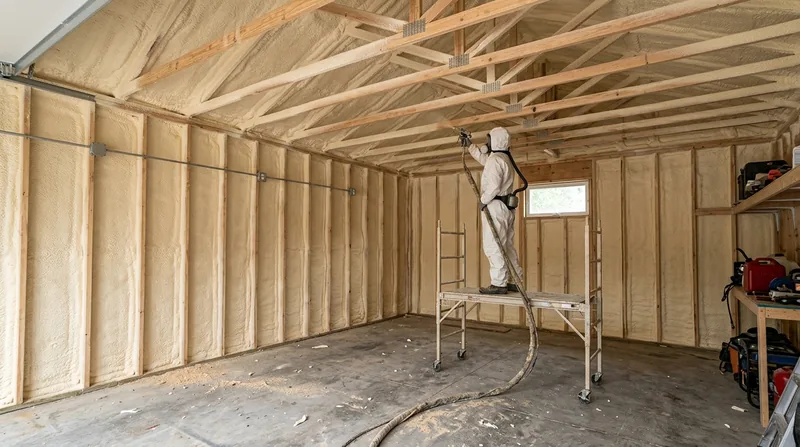




Garage spray foam insulation in Asheville stops the temperature swings that make mountain garages nearly unusable half the year. On these sloped Buncombe County lots, detached shops and attached bays face humid summers that push moisture inward and winter cold snaps that reverse that drive. Uninsulated garage walls and ceilings become condensation traps, sweat pools, and rust factories for tools and equipment. We spray foam the walls and ceiling to even out temperatures, block moisture from settling, and make the space functional year-round, whether it's a detached workshop near Black Mountain or an attached bay in Weaverville. This is not a cosmetic upgrade; it's climate control for a space that sits exposed to both seasons.
Why Garage Spray Foam Insulation Matters in Asheville's Mountain Climate
Garages in Greater Asheville experience temperature extremes that uninsulated walls cannot handle. Summer humidity drives moisture into the space, settling on metal and concrete. Winter cold snaps pull that moisture back out, but not before rust and mildew take hold. Spray foam blocks both the air leakage and the vapor drive, creating a sealed thermal envelope that keeps the interior stable. A garage in Fairview or Fletcher that swings from 95 degrees in July to 25 degrees in January will see condensation, corrosion, and structural wood rot without intervention. Spray foam stops that cycle.
- We seal all wall cavities and the ceiling to eliminate air leakage that lets outside humidity enter.
- Closed-cell foam adds structural rigidity and blocks vapor, critical on mountain lots where humidity swings are sharp.
- Open-cell foam offers a lower-cost option for detached garages where the space does not need to condition equipment or vehicles year-round.
- We air-seal penetrations, rim joists, and band joists where the garage meets the house foundation or sill plate.
Every garage job starts with a clear picture of what you store and how you use the space, then we match the foam type and thickness to that need.
Local example: A detached shop in Swannanoa storing hand tools and a woodworking bench saw rust and finish damage every winter from condensation. Closed-cell spray foam on the walls and ceiling, with proper ventilation during cure, stopped the moisture in-migration and added R-18 to R-24 depending on thickness, making the space usable ten months a year instead of four.
For regulatory guidance on attic ventilation, thermal barriers, and ignition barriers in your specific zone, see the Buncombe County Inspections Department, which enforces the energy and building code at your address.
How We Insulate and Air-Seal Garages in Asheville
Garage spray foam insulation starts with a walk-through to map the scope: attached or detached, what the walls and ceiling are made of, access for the spray rig, and whether any existing insulation needs removal. We measure the cavity depth, confirm the foam type (closed-cell or open-cell) based on your use and budget, and set up mechanical ventilation during the spray and cure phases. Proper installation controls the foam ratio, drum temperature, and spray passes to ensure uniform density and the R-value you paid for. We do not rush cure; we state a re-entry window of 24 to 48 hours and we mean it.
- We inspect the existing structure, framing, and any prior insulation to identify moisture, rot, or pest damage before we start.
- We set up temporary barriers and mechanical ventilation to control fumes and ensure safe air quality during spray and cure.
- We spray the walls, ceiling, and rim joists in controlled passes, building thickness and density in layers rather than one heavy pour.
- We trim excess foam flush with the framing and install fire-rated facings if code at your address requires them.
- We provide a written report with R-value, thickness, foam type, and re-entry instructions before we leave the job.
The entire process for a typical attached garage takes one to two days of active work, plus a 24 to 48-hour cure window before you can use the space.
Real scenario: A homeowner in Hendersonville with an attached two-car garage wanted to store a classic car year-round. We sprayed 2 inches of closed-cell foam on the walls and ceiling, sealed the band joists where the garage met the house foundation, and air-sealed penetrations around electrical and HVAC chases. The space now holds temperature within 10 degrees of the house interior, humidity stays below 60 percent, and the car stays dry. Total installed cost was well within budget because we sized the foam to the actual need, not the biggest number.
Learn more about how we handle air sealing and moisture control across all our services at Air Sealing in Asheville.
Garage Spray Foam Insulation Methods and Approaches
| Approach | Description | Best for |
|---|---|---|
| Closed-Cell Spray Foam | High-density foam with closed cell structure, R-6 to R-7 per inch, vapor barrier and structural reinforcement included. | Attached garages, equipment storage, mountain locations with sharp humidity swings, and spaces where the garage is conditioned. |
| Open-Cell Spray Foam | Lower-density foam with open cell structure, R-3.5 per inch, air-sealing without vapor barrier, more cost-effective. | Detached shops, tool storage, and spaces where temperature control is secondary to air sealing and sound dampening. |
| Foam + Blown-In Cellulose Hybrid | Spray foam on the ceiling and upper walls for air sealing, blown cellulose below for cost savings and fire rating. | Budget-conscious retrofits where the primary need is ceiling insulation and the walls can be addressed in phases. |
| Rim and Band Joist Sealing | Closed-cell foam applied to the rim joist where the garage meets the foundation, blocking cold and moisture infiltration. | Any attached garage; this is the single most cost-effective energy upgrade and the first step in a phased insulation plan. |
Garage Spray Foam Insulation Cost in Asheville: What to Expect
Garage spray foam insulation in Asheville starts at around $1,200 for a small detached shop or a partial rim joist and ceiling seal on an attached garage. A full two-car attached garage with walls and ceiling runs $2,500 to $4,500 depending on cavity depth, foam type, and whether existing insulation must be removed first. Detached garages on steep lots in Black Mountain or Weaverville may cost more if access is tight or if the structure has unusual framing. The biggest cost driver is whether you choose closed-cell or open-cell foam; closed-cell costs more per board foot but delivers higher R-value and vapor blocking, which matters on mountain properties where humidity swings are severe.
Other factors that move the price are the size of the space, the number of penetrations to seal, the condition of existing insulation, and whether the job requires removal of old batts or mineral wool. A garage with a vaulted or cathedral ceiling costs more than one with a flat roof. A structure with poor access or tight framing takes longer and costs more. The only way to get an accurate number is an on-site estimate where we measure, assess the substrate, and quote the specific scope you need.
For a detailed breakdown of our pricing across all service types and a real-world sense of what drives the cost up or down, see Pricing and Estimates.
Garage Spray Foam Insulation Near Me: What Asheville Homeowners Should Know When Hiring
Hiring a spray foam contractor is a high-stakes decision because bad installation leaves you with an unusable space, a chemical smell that lingers, and no recourse. When you are evaluating any contractor, including us, verify their insurance and get three written estimates that spell out foam type, thickness in inches, R-value per inch, and the total R-value of the finished job. Ask for references from recent garage jobs in your neighborhood and call them. Understand what permits your city requires; Asheville, Weaverville, Fletcher, and other municipalities have different rules on thermal barriers, ignition barriers, and inspection timing, so confirm with your local building department before you sign. If you have an HOA, check whether exterior work on a detached garage requires architectural approval. Do not accept a price-per-board-foot quote without an on-site inspection, and do not believe promises of immediate re-entry or a smell-free cure; proper spray foam requires ventilation and a 24 to 48-hour re-entry window.
- Ask for proof of current general liability and property damage insurance; we carry full coverage and provide a certificate on request.
- Get written estimates from at least two other contractors and compare the foam type, thickness, R-value, and workmanship warranty.
- Call references who had garage work done in the last two years and ask whether the smell was managed, whether the cure timeline was honored, and whether the space has stayed dry and temperature-stable.
- Confirm with your city building department whether permits are required and whether a thermal barrier or ignition barrier is mandated for your address.
- Understand the workmanship warranty; we stand behind our installations for one year, and any defects in application are corrected at no charge.
A reputable local contractor will answer every question in writing, will not pressure you into a same-day booking, and will explain why the estimate costs what it does.
Ready to get a free estimate? Call us at (828) 519-0053 or request an estimate online. We respond within 24 hours and there is no obligation to book.
Garage Spray Foam Insulation in Asheville: Pricing Guide
| Service | Price | Details |
|---|---|---|
| Rim and band joist sealing | Starting at $800 | Closed-cell foam applied to the rim joist where the garage meets the foundation, blocking cold and moisture infiltration. |
| Detached garage ceiling only | Starting at $1,200 | Open-cell or closed-cell foam on the ceiling of a small detached shop or storage building, typically 200 to 400 square feet. |
| Attached two-car garage, walls and ceiling | Starting at $2,500 | Closed-cell foam on all walls and ceiling of a standard two-car attached garage, including band joist sealing and penetration air sealing. |
| Full garage retrofit with insulation removal | On estimate | Removal of old batts, mineral wool, or failed foam, plus new spray foam installation; requires on-site inspection to price accurately. |
| Travel and estimate | Free | No mileage fee or travel charge within Asheville and surrounding areas; free written estimate with R-value and thickness specifications. |
Indicative pricing, the exact cost depends on square footage, finish, and site access. Free personalized estimate within 24h at (828) 519-0053.


