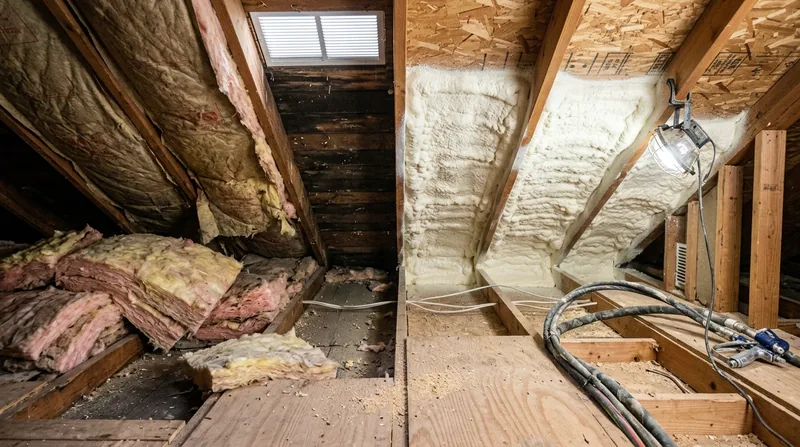




Insulation Replacement & Re-Insulation in Asheville means pulling out failed, compressed, or moisture-damaged insulation and installing spray foam sized for this mixed-humid climate zone where seasonal vapor drive shifts direction twice a year. Older Asheville homes in Kenilworth, West Asheville, and Montford sit over damp crawl spaces or basements on sloped mountain lots, with original wall cavities under-insulated and attics leaking conditioned air through top plates and rim board penetrations. Mid-century ranches across Buncombe County carry flattened batt insulation in vented attics that no longer perform, while mountain homes near Black Mountain, Weaverville, and Arden deal with rim and band joists exposed to winter cold snaps and moisture inflow. Replacing insulation gives these homes a chance to fix both heat loss and moisture control at once, and to do it right for the climate you actually live in. We remove worn material, seal air leaks, and install spray foam in the thickness and density that this climate demands.
Why Insulation Replacement Matters in Asheville's Mixed-Humid Climate
Asheville sits in IECC climate zone 4A, where humidity and temperature shifts reverse the direction of moisture flow through walls and attics twice a year. Summers push moisture inward; winters pull it back out. Insulation that was never right for this climate, or that has settled, absorbed moisture, or been damaged by roof leaks, stops working and starts trapping water. Damp crawl spaces under older Asheville homes create upward vapor pressure that old fiberglass cannot stop. Attics in vented conditions leak warm air in winter and draw hot, humid air inward in summer, then the insulation that is supposed to resist that drive has already failed.
- Flattened or compressed batt insulation loses R-value and allows air to move around fibers instead of through them.
- Fiberglass and cellulose absorb moisture in humid attics and crawl spaces, losing insulation value and becoming a vector for mold growth.
- Spray foam seals the air leaks that fiberglass never addresses, stopping both heat loss and moisture infiltration in one pass.
- Replacement lets you upsize R-value to match current code and climate demand without demolishing walls.
Getting the insulation right the first time stops energy bills from climbing and keeps the structure dry year-round.
Key info: In Montford and Kenilworth, homes built before 1980 often have crawl spaces with no vapor barrier and rim joists with zero insulation. Replacing attic insulation alone will not fix a damp crawl space, but replacing insulation in both zones stops the moisture drive and the conditioned air loss that tracks energy bills higher every year.
North Carolina building code and local permitting rules govern attic ventilation and thermal barrier requirements at your address. Always check with your local building department or city inspector before starting work. The North Carolina Department of Insurance maintains contractor registration and complaint records for your area.
How Insulation Replacement & Re-Insulation Works in Asheville Homes
The process begins with an on-site look at what is there now, how much of it has failed, what moisture or air-leak issues exist, and what the local code requires for your address. We pull out the old material, seal the major air leaks in rim board, top plate, and penetrations, then install spray foam at the thickness and density that this climate zone demands. The choice between closed cell and open cell foam depends on the zone, the moisture risk, and your budget. Closed cell spray foam is the standard for crawl spaces, rim joists, and any zone where moisture control is the priority; open cell spray foam is the cost-friendly option for dry attics where air sealing is the main job.
- We inspect the existing insulation and identify moisture, air leaks, and structural damage that must be addressed before foam is applied.
- We remove all failed insulation, debris, and contaminants down to a clean substrate.
- We seal the rim board, top plate, and major penetrations with foam or caulk before the main insulation pass.
- We apply spray foam at the manufacturer ratio and thickness specified for your zone and use case.
- We provide mechanical ventilation during cure and a re-entry window of twenty-four to forty-eight hours before you occupy the space.
The job is sized on site, measured in board feet, and quoted with R-value and thickness specs so you know exactly what you are getting.
Example: A Weaverville ranch with a vented attic and R-19 batts compressed to R-8 needs the old insulation removed, the attic sealed at the rim and top plate, then closed cell or open cell foam installed to R-30 or R-38 depending on code and your heating load. The job takes one to two days, costs from $2,800 to $4,200, and stops the air leaks that were costing $40 to $80 a month in wasted conditioning.
Insulation Replacement Methods: Closed Cell, Open Cell, and When to Choose Each
| Approach | Description | Best for |
|---|---|---|
| Closed Cell Spray Foam Replacement | High-density foam that creates a vapor barrier and air seal in one pass. R-value approximately 6.5 to 7.0 per inch. Resists moisture and does not absorb water. | Crawl spaces, rim joists, band joists, vented attics in high-moisture zones, and any space where vapor control is the priority. |
| Open Cell Spray Foam Replacement | Lower-density foam that air-seals but allows vapor to move through it. R-value approximately 3.5 to 3.8 per inch. Lower cost per board foot than closed cell. | Attics in dry climates or sealed attics where vapor permeability is acceptable, interior wall cavities, and sound dampening applications. |
| Insulation Removal and Replacement | Complete tearout of failed fiberglass, cellulose, or old foam, followed by cleaning and disposal. Substrate is prepared for new foam application. | Any attic, crawl space, or wall cavity where existing insulation has failed, absorbed moisture, or is contaminated with debris or mold. |
| Rim Joist and Band Joist Replacement | Closed cell foam applied to the exposed rim board and band joist on the exterior rim of the foundation. Seals air leaks and resists moisture from below. | Older Asheville homes with uninsulated rim joists, homes in Black Mountain and Weaverville exposed to winter cold, and any structure with a damp basement or crawl space below. |
Insulation Replacement & Re-Insulation Cost in Asheville: What to Expect
Insulation replacement pricing depends on the size of the space, the type and amount of material being removed, the foam type and thickness required by code and climate, and access difficulty. A typical attic replacement in Asheville or Weaverville starts at $2,800 for a smaller ranch and can run $4,500 to $6,500 for a larger home or a job that includes crawl space work. Crawl space replacement with closed cell foam is usually higher per square foot because moisture control and vapor barrier function are non-negotiable. Rim joist wrapping is a smaller ticket, typically $1,200 to $2,400 depending on the perimeter and whether the rim is accessible. See the full pricing page for ranges by zone and service type.
The factors that move cost up are the volume of old insulation to remove and dispose of, the presence of moisture or contamination that must be cleaned before foam is applied, the R-value and thickness required by your local code, and the difficulty of access (attics with low headroom, crawl spaces under additions, or rim joists on multi-level homes cost more to reach and spray). Getting written estimates from two or three contractors, each with R-value and thickness specs in writing, is the only way to compare apples to apples and to spot the estimator who is guessing instead of measuring.
Key info: Do not accept an estimate with no R-value and no thickness. Do not accept a price quoted per square foot without a board-foot count on site. Any contractor who promises an immediate re-entry window or who does not mention mechanical ventilation during cure is cutting corners. Get the estimate in writing and ask for the manufacturer name, the ratio of the foam, and the re-entry window in hours.
Insulation Replacement & Re-Insulation Near Me: What Asheville Homeowners Should Know Before Hiring
Hiring a spray foam insulation contractor for replacement work is a bigger decision than hiring for a small rim joist job, because the work affects the whole house and runs for several days. Verify that any contractor you call is fully insured and can provide a certificate of insurance naming your address. Ask for at least two references from similar jobs done in the last two years, and call them. Understand your local building department's permitting rules for your address; some Asheville neighborhoods and HOAs have specific requirements for attic work, and your contractor should help you navigate what applies at your house, not claim to "pull all permits" (permitting authority and responsibility rest with the city, not the contractor). Always get the estimate in writing with R-value, thickness, and the square footage or board footage of the job spelled out.
- Ask the contractor to name the local building department and confirm what permits and inspections apply to your job.
- Request a written estimate that includes the foam type, R-value per inch, total thickness, board footage, and the re-entry window in hours.
- Verify insurance by asking for a certificate of insurance and checking it covers the scope of work at your address.
- Ask whether the contractor will provide mechanical ventilation during cure and what re-entry timeline they guarantee.
- Get the estimate on paper and do not agree to start work until you have signed it and understand what is included and what is not.
The right contractor will answer every question clearly, will not pressure you into an immediate decision, and will explain why the foam type and thickness they recommend fits your climate zone and your home. Contact us for a free estimate with no obligation, or call (828) 519-0053 to discuss your job and get a timeline.
Insulation Replacement & Re-Insulation in Asheville: Pricing Guide
| Service | Price | Details |
|---|---|---|
| Attic Insulation Replacement | Starting at $2,800 | Includes removal of old insulation, air sealing at rim and top plate, and spray foam to code R-value for your attic zone |
| Crawl Space Replacement with Closed Cell Foam | Starting at $3,600 | Complete removal of old insulation and debris, closed cell foam application with vapor barrier, includes rim board sealing |
| Rim Joist and Band Joist Wrapping | Starting at $1,200 | Closed cell foam applied to exposed rim board perimeter, sealed and finished, sized per foundation length and accessibility |
| Multi-Zone Replacement (Attic + Crawl Space + Rim) | On estimate | Larger projects combining multiple zones require on-site measurement to calculate total board footage and labor schedule |
| Estimate and Site Inspection | Free | Written estimate with R-value and thickness specs provided within twenty-four hours, no obligation to proceed |
Indicative pricing, the exact cost depends on square footage, finish, and site access. Free personalized estimate within 24h at (828) 519-0053.


