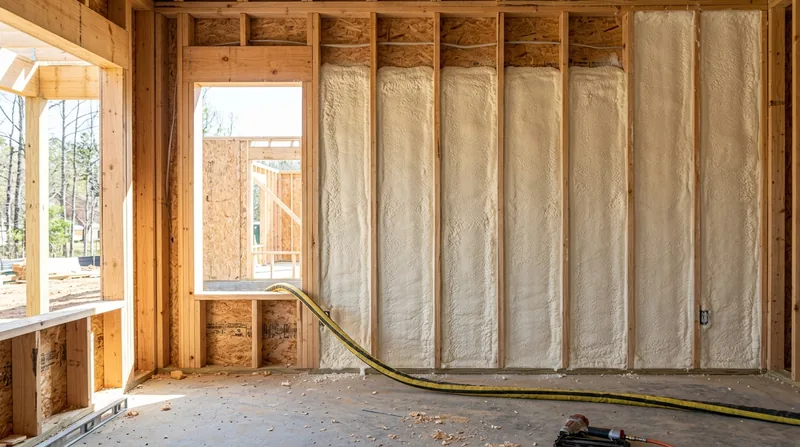




Commercial and new construction spray foam insulation in Asheville demands a different approach than retrofit work on older homes. New builds pushing out toward Weaverville and Arden, and commercial shells across Buncombe and Henderson counties, start with tighter envelopes but still need careful planning around attic venting strategy, crawl space moisture control, and rim and band joist air sealing before the drywall goes up. We work with builders and general contractors to get the thermal and air boundary right the first time, avoiding the costly rework that comes from guessing on venting or moisture. Asheville's mixed-humid climate means both summer moisture inward drive and winter reverse drive, so new construction here cannot rely on passive venting alone. Getting spray foam and air sealing locked in during framing saves months of callbacks and keeps energy performance honest from day one.
Why Commercial and New Construction Spray Foam Matters on Asheville Building Sites
New construction in the Asheville area sits in IECC climate zone 4A, where seasonal moisture drive shifts direction. Summer humidity pushes inward through any air leak in the envelope, and winter cold reverses that drive outward. A builder who vents an attic passively and calls it done will face condensation on sheathing, mold risk, and angry calls mid-winter. Spray foam and sealed attics eliminate that risk, but only if the work is done right and the venting strategy is locked in before framing closes. Commercial shells for light industrial or retail use the same logic: a tight, sealed roof deck with closed cell foam stops condensation on the steel frame and keeps HVAC loads predictable. Crawl spaces under new homes on Asheville's sloped terrain need moisture control from day one, not remediation three years later when the joists are soft.
- We confirm attic venting strategy with the builder and local building official before any spray work begins.
- We spray rim and band joists to code-required R-value and thickness, documented in writing on every estimate.
- We air seal all penetrations, top plates, and rim details so the thermal boundary is continuous and measurable.
- We work on commercial shells to meet both energy code and condensation control on steel framing and metal deck.
- We remove and replace failed insulation in new construction when prior trades leave wet substrate or contamination.
Getting spray foam and air sealing right during construction is far cheaper and faster than retrofitting a leaky, moldy attic after occupancy. North Carolina's building code sets R-value and thickness minimums that vary by climate zone and assembly type, and we document every job to those specs.
Key info: New construction in Asheville, Weaverville, and Black Mountain must navigate attic venting rules set by the local building official, not by us. We help builders understand the options (sealed attic with spray foam, vented attic with batt, hybrid venting) and execute the chosen strategy correctly. Air sealing during framing is the single biggest insurance against callbacks and warranty claims.
How We Work with Builders and General Contractors in Asheville
Our process on new construction sites is structured to fit builder schedules and code deadlines. We meet early with the GC and framing crew to review the insulation scope, confirm attic and crawl space venting strategy, and identify any moisture risks. We then coordinate spray timing so foam goes in after framing but before roof sheathing nails down, or after the shell is closed but before drywall, depending on the venting plan. Every job gets a written estimate with R-value, thickness in inches, board foot count, and the specific code section we are meeting. We bring mechanical ventilation to the site during cure to manage VOCs and ensure safe re-entry windows, and we leave the builder with documentation of what was sprayed where.
- We schedule spray work to coordinate with framing, roof sheathing, and drywall timelines on the builder's calendar.
- We provide written specifications before any work begins, including R-value, thickness, board feet, and code compliance.
- We use closed cell spray foam on rim and band joists, crawl spaces, and commercial metal frames where moisture or condensation risk is high.
- We use open cell spray foam in sealed attics where cost control matters and the assembly is protected from exterior moisture.
- We manage mechanical ventilation during cure and document the re-entry window so the builder knows when drywall crews can return.
This structured approach keeps the builder on schedule and eliminates the guesswork that leads to callbacks, warranty disputes, and energy performance failures after occupancy.
Real example: A new barndominium near Weaverville required a sealed attic with closed cell spray foam on the roof deck to control condensation from winter humidity and summer air conditioning load. We coordinated with the framing crew to spray after sheathing but before metal roofing, then worked with the GC to confirm re-entry timing so HVAC rough-in could proceed on schedule. The builder received a one-page spec sheet naming R-value, thickness, board feet, and the energy code section satisfied. No callbacks, no moisture risk, no surprises.
Commercial and New Construction Spray Foam Methods
| Approach | Description | Best for |
|---|---|---|
| Closed Cell Spray Foam on Rim and Band Joists | 1.5 to 2 inch closed cell foam sprayed to R-9 to R-13 per inch, creating a continuous air and moisture barrier at the foundation edge. | New construction in Asheville's cold winters and damp crawl spaces, commercial buildings with steel frames, and retrofit work on older homes with rim joist air leaks. |
| Sealed Attic with Open Cell Spray Foam | 3.5 to 5.5 inch open cell foam on the roof deck to R-13 to R-21, creating a tight thermal boundary and allowing roof sheathing to dry to the interior. | New construction where cost control is important and the attic is sealed from exterior moisture, typical on new homes in Weaverville and Fairview. |
| Sealed Attic with Closed Cell Spray Foam | 2 to 3 inch closed cell foam on the roof deck to R-13 to R-21, providing both thermal resistance and vapor barrier in one pass. | Commercial buildings, metal frame construction, and new homes where moisture or condensation risk is high or where vapor control is required by code. |
| Crawl Space Spray Foam with Rim Joist Air Sealing | Closed cell foam on rim and band joists plus spray on foundation walls or rim blocking to create a continuous thermal and air boundary below grade. | New construction on sloped Asheville terrain where crawl spaces are common, and retrofit work on older homes with damp, drafty crawl spaces. |
| Commercial Metal Building Roof Deck Spray | Closed cell foam sprayed to 2 to 4 inches on the underside of metal roof deck or purlin to control condensation and provide R-value on steel. | Light industrial, retail, and agricultural metal buildings across Buncombe and Henderson counties where condensation on steel causes rust and moisture damage. |
Commercial and New Construction Spray Foam Cost in Asheville: What to Expect
Cost for commercial and new construction spray foam depends on several concrete factors: the square footage of the assembly being sprayed, the R-value and thickness required by code, whether the substrate is clean and dry, site access for our equipment, and whether the work is on an attic, crawl space, rim joist, or metal frame. A new home rim joist and band joist air sealing typically runs from $800 to $2,000 depending on the linear footage and whether crawl space work is included. A sealed attic on a 2,000 square foot home can range from $2,500 to $5,500 for open cell or $4,000 to $8,000 for closed cell, depending on R-value target and roof complexity. Commercial metal building roof deck spray on a 10,000 square foot structure can range from $8,000 to $18,000 depending on thickness and ease of access. The best way to understand cost for your specific project is to request a free commercial estimate with R-value and thickness specs in writing.
We do not quote spray foam by the board foot over the phone because the thickness, coverage pattern, and substrate condition all affect the actual count. Getting 2 to 3 written estimates from contractors who specify R-value and thickness in inches is the only way to compare fairly. Watch out for estimates with no R-value, no thickness, no board foot total, or a price far below market with no inspection. Those are the markers of a rig-and-run crew or a franchise outfit that will be gone when the smell will not fade or the foam cracks.
What to Look for When Hiring a Spray Foam Contractor Near Asheville
Hiring the right spray foam contractor for new construction or a commercial project in Asheville, Weaverville, or Black Mountain requires checking several concrete things. First, confirm the contractor is fully insured and can provide a current certificate of insurance naming your builder or project as an additional insured. Second, ask for a written estimate that includes R-value in inches per inch of foam, total thickness, board foot count, and the specific energy or building code section being satisfied. Third, ask about the contractor's process for mechanical ventilation during cure and the re-entry window they guarantee. Fourth, check references from other builders or GCs in the Asheville area, not just homeowners, because commercial and new construction work is different from attic retrofit. Fifth, verify that the contractor understands local permitting and venting rules by asking them to walk you through what applies at your address before any work begins.
- Request a written estimate with R-value, thickness in inches, board feet, and code section cited, not a verbal price.
- Confirm the contractor is fully insured and will add your project as an additional insured on their policy.
- Ask about mechanical ventilation during cure and the re-entry window promised so your schedule stays on track.
- Check references from other builders or GCs, not just homeowners, to verify experience on commercial and new construction projects.
- Verify the contractor understands local venting rules, moisture control strategy, and how to coordinate with your building department before starting work.
The contractor you choose should treat new construction and commercial work as a planned, documented process, not a quick spray job. If they cannot explain their venting strategy, their ventilation process during cure, or their code compliance in writing, find someone else. Call us at (828) 519-0053 to discuss your new construction or commercial insulation scope and get a free written estimate with R-value and thickness specs included.
Commercial & New Construction Spray Foam in Asheville: Pricing Guide
| Service | Price | Details |
|---|---|---|
| Rim and Band Joist Air Sealing | $800 to $2,000 | Closed cell spray foam on rim joists to R-9 to R-13, includes linear footage and crawl space access difficulty |
| Sealed Attic with Open Cell Spray Foam | $2,500 to $5,500 | 3.5 to 5.5 inches on roof deck for 2,000 sq ft home, includes R-value target and roof complexity |
| Sealed Attic with Closed Cell Spray Foam | $4,000 to $8,000 | 2 to 3 inches on roof deck for 2,000 sq ft home, includes vapor control and condensation prevention on steel |
| Commercial Metal Building Roof Deck | $8,000 to $18,000 | Closed cell spray on 10,000 sq ft metal frame, cost varies by thickness requirement and site access |
| Free Written Estimate | Free | Includes R-value, thickness in inches, board feet, code section, and re-entry window documented in writing |
Indicative pricing, the exact cost depends on square footage, finish, and site access. Free personalized estimate within 24h at (828) 519-0053.


