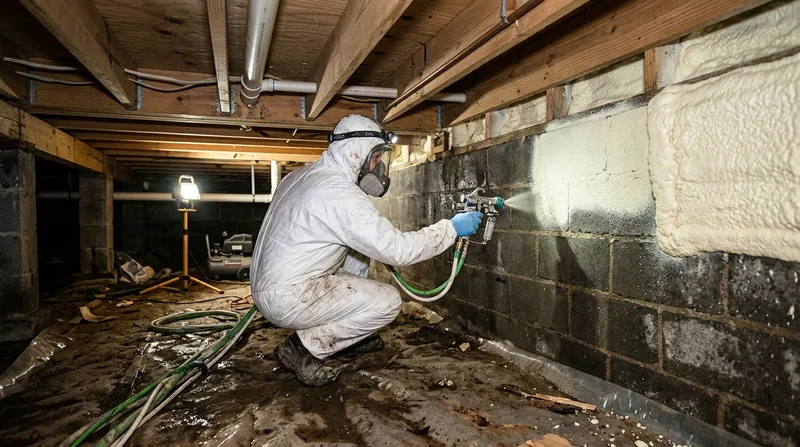




Crawl Space Spray Foam Insulation in Asheville stops moisture and cold from below, where mountain sloped lots and seasonal humidity shifts create the conditions for damp crawl spaces year-round. Asheville's mixed-humid climate (IECC zone 4A) means humid summers push moisture inward through crawl space walls, and cold winters reverse that flow, trapping water vapor and chilling floor joists. Older homes in Montford, Kenilworth, and West Asheville sit over crawl spaces that stay damp through both seasons, and mid-century ranches across Buncombe County carry rim and band joists exposed to winter cold snaps. We spray closed-cell or open-cell foam across crawl space walls and band joists to block moisture infiltration, seal air leaks, and keep floors warmer. The result is lower humidity under the house, fewer drafts at floor level, and reduced energy cost to condition upper floors.
Why Crawl Space Spray Foam Matters in Asheville and Buncombe County
Crawl spaces on Asheville's sloped terrain collect and hold moisture because water naturally runs downhill and settles in the lowest part of the home. Asheville averages 47 inches of rain per year, and that water finds its way into crawl spaces through soil contact, cracks in block walls, and rim board gaps. A damp crawl space becomes a cold crawl space in winter, and cold floors upstairs mean your HVAC system works harder to heat living spaces. Moisture also fuels mold growth on band joists and rim boards, degrades insulation batts that may already be in place, and attracts wood-destroying insects. Spray foam seals the crawl space to outside air and moisture, creating a conditioned or semi-conditioned buffer zone under your floors.
- Seal rim and band joists where they meet the foundation wall, eliminating the single largest air leak path in most homes.
- Block moisture vapor from soil and outside air from entering crawl space walls, reducing humidity and mold risk.
- Insulate the thermal boundary of the crawl space itself, so floors stay warmer and require less heating energy.
- Protect existing mechanical systems and ductwork in the crawl space by keeping the space dry and at a stable temperature.
Homes in Fletcher, Black Mountain, and Weaverville see the same problem: damp crawl spaces mean cold floors and higher energy bills, and spray foam stops both.
Key info: Your local building department can tell you what applies at your address.
For more on the moisture and air sealing picture, see our air sealing service page.
How We Spray Foam Crawl Spaces in Asheville: Process and Technique
Crawl space spray foam work starts with a site visit to assess the crawl space size, wall condition, existing insulation or debris, and access points. We measure the perimeter of the crawl space and the height of the rim board and band joist area, then estimate the board feet of foam needed. We remove old fiberglass batts or cellulose if present (see our insulation removal page for details), clean the substrate, and verify the crawl space is dry before we spray. If standing water or active moisture is present, we stop and refer you to a crawl space encapsulation or water management contractor first. Once the space is ready, we spray the walls and band joists with the foam type that matches your needs, apply the required thermal barrier or ignition barrier per code, and establish a re-entry window of 24 to 48 hours.
- We inspect the crawl space for structural damage, standing water, and existing insulation before providing an estimate.
- We remove old fiberglass, cellulose, or failed foam if it is present and blocking access or reducing foam performance.
- We spray closed-cell foam at the specified thickness (typically 1.5 to 2 inches for R-value and vapor barrier performance) on walls and band joists.
- We apply an intumescent paint or other thermal barrier as required by North Carolina energy and building code at your address.
- We provide a written estimate with R-value, thickness, and board-foot total so you know exactly what you are paying for.
A typical crawl space under a ranch or small home in Asheville or Weaverville takes one to two days; larger or multi-section crawl spaces may require a second day.
Local example: A 1,200 square foot ranch in West Asheville with a 40-foot perimeter crawl space and existing wet fiberglass batts: we remove the old batts, clean the rim board and walls, spray 1.5 inches of closed-cell foam (R-9 per inch), and apply a thermal barrier. Total board feet: roughly 60 to 80, depending on wall height and band joist configuration. Job takes one day, re-entry in 48 hours.
Crawl Space Spray Foam Methods: Closed Cell vs. Open Cell
| Approach | Description | Best for |
|---|---|---|
| Closed-Cell Foam | 1.5 to 2 inch layer sprayed on crawl space walls and band joists; provides R-value of 6 to 7 per inch and acts as a vapor barrier; denser, more rigid, resists moisture and air infiltration. | Damp crawl spaces, band joists exposed to winter cold, and where vapor barrier performance is critical to prevent moisture migration. |
| Open-Cell Foam | 3 to 4 inch layer sprayed on crawl space walls; provides R-value of 3.6 per inch; softer and more flexible, allows drying to interior if moisture enters, lower cost per board foot. | Crawl spaces with good drainage and lower moisture risk; homeowners prioritizing lower upfront cost over maximum vapor barrier performance. |
| Closed-Cell + Rim Joist Focus | Closed-cell foam applied primarily to rim and band joists (1.5 to 2 inches) with minimal coverage of crawl space walls; seals the air leak path at the rim while keeping wall treatment light. | Homes where the main goal is to stop drafts at floor level and warm floors; good balance of cost and performance for mild-to-moderate moisture risk. |
| Removal and Replacement | Old foam or fiberglass removed, substrate cleaned and dried, new closed-cell or open-cell foam applied per current code and specifications. | Crawl spaces with failed, water-damaged, or undersized existing insulation; retrofit of mid-century homes across Buncombe and Henderson counties. |
For more on closed-cell foam and its R-value performance, see our closed-cell spray foam page.
Crawl Space Spray Foam Insulation Cost in Asheville: What to Expect
Crawl space spray foam insulation in Asheville typically starts at $2,500 for a small to mid-size crawl space under a ranch or cottage, and can range from $3,500 to $6,000 or more for larger homes, multi-section crawl spaces, or homes that require full removal of existing insulation first. Cost depends on four main factors: the linear feet of rim and band joist to cover, the total square footage of crawl space walls to insulate, the depth and access of the crawl space, and whether old insulation must be removed and hauled away. A closed-cell application costs more per board foot than open-cell because it delivers higher R-value and vapor barrier performance; a crawl space with existing wet fiberglass or cellulose costs more because removal labor is added. Crawl spaces in Fairview, Swannanoa, or Fletcher with easy access and good headroom take less time and cost less than tight, low-headroom spaces in older homes on steep lots.
The best way to get an accurate number is to request a free, written estimate that includes the board-foot total, R-value per inch, foam type, and thickness spec. We provide estimates within 24 hours at (828) 519-0053, with no obligation to book. See our pricing page for more detail on factors that move the final cost.
What to Look for When Hiring a Spray Foam Insulation Contractor Near Me in Asheville
Hiring the right spray foam contractor is as important as choosing the right foam type, because poor installation, wrong ratio, inadequate ventilation during cure, and shortcuts on thermal barriers create risk. A reputable contractor is fully insured, provides written estimates with R-value and thickness specs (not vague prices per square foot), and is reachable by phone and email after the job. Check references from recent crawl space jobs in Asheville or nearby towns, and ask whether the contractor follows the foam manufacturer's cure time and re-entry protocol (typically 24 to 48 hours with mechanical ventilation). Verify that the contractor is familiar with North Carolina building code requirements for thermal barriers and ignition barriers, and confirm what permits, if any, are needed at your address (permitting varies by city, and there is no reciprocity across Buncombe, Henderson, and surrounding counties). If you live in a master-planned community or HOA area, check whether architectural review applies to crawl space work (it rarely does for interior insulation, but always confirm). Ask your contractor how they verify the substrate is dry before spraying, and what happens if moisture is found (the answer should be: we address the moisture source first or we walk away).
- Verify the contractor is fully insured and can provide a current certificate of insurance before work begins.
- Request written estimates from at least two contractors so you can compare foam type, thickness, board footage, and price.
- Ask for references from at least two crawl space jobs completed in Asheville or nearby towns within the past 12 months.
- Confirm the contractor understands permitting and code requirements for crawl space insulation at your specific address.
- Check that the contractor uses mechanical ventilation during cure and observes the manufacturer's re-entry time (24 to 48 hours).
For a free estimate and to discuss your crawl space, contact us at our contact page or call (828) 519-0053.
Crawl Space Spray Foam Insulation in Asheville: Pricing Guide
| Service | Price | Details |
|---|---|---|
| Small crawl space (under 800 sq ft, minimal existing insulation) | Starting at $2,500 | Closed-cell foam on rim joist and band joist, minimal wall coverage, good access, no removal work required |
| Medium crawl space (800 to 1,500 sq ft, with old fiberglass or cellulose) | Starting at $4,000 | Closed-cell or open-cell foam on walls and band joists, includes removal and haul of old insulation, typical access and headroom |
| Large crawl space (over 1,500 sq ft, multi-section, low headroom, or complex access) | Starting at $5,500 | Full wall and rim joist coverage, removal of existing insulation, tight or difficult access, possible second day labor |
| Complete crawl space retrofit with full removal | On estimate | Site inspection required to assess substrate condition, moisture history, existing insulation type and volume, and headroom constraints |
| Travel within Asheville and surrounding areas | Included | No separate travel fee or mileage charge for jobs in Buncombe, Henderson, Haywood, Rutherford, Jackson, and McDowell counties |
| Free written estimate | No charge | Response within 24 hours at (828) 519-0053, includes board feet, R-value, foam type, thickness, and thermal barrier notes |
Indicative pricing, the exact cost depends on square footage, finish, and site access. Free personalized estimate within 24h at (828) 519-0053.


