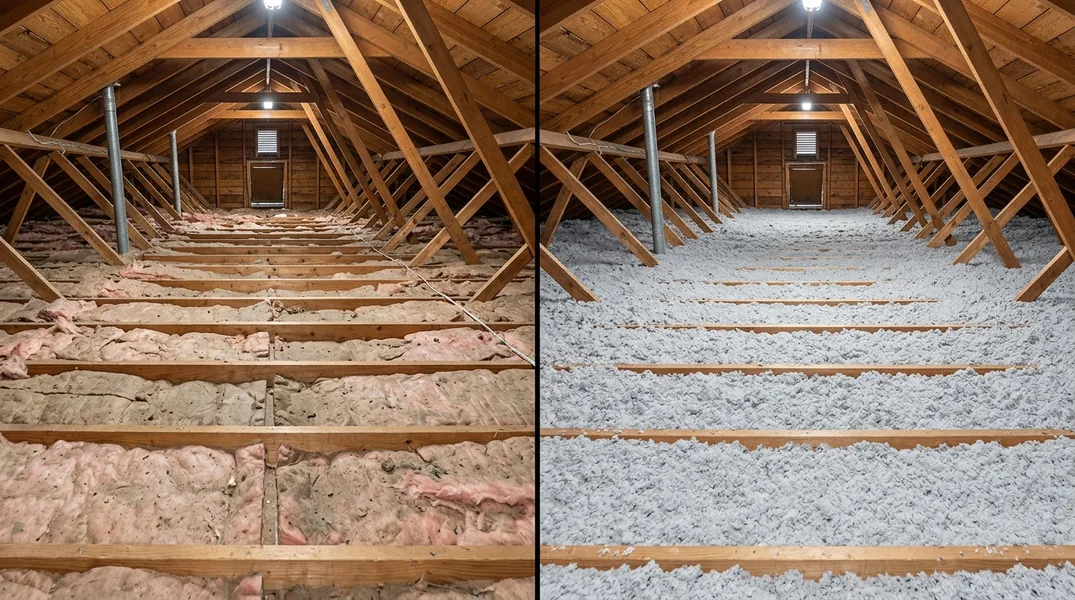
The Mid-Century Ranch Problem: Flattened Insulation in Buncombe County
If you own a mid-century ranch home across Buncombe County, you've likely inherited a charming architectural style that defined American suburban living from the 1950s through the 1970s. These homes, with their low-pitched roofs, open floor plans, and efficient designs, remain popular throughout Asheville and surrounding communities. However, many of these vintage properties share a common problem: deteriorating attic insulation that no longer performs as intended.
Over decades, the blown-in insulation commonly installed in these ranches has compressed, settled, and lost its thermal resistance. Gravity, moisture, and the natural breakdown of materials cause cellulose and fiberglass to compact into dense layers that trap little air and provide minimal R-value. Homeowners often notice higher heating and cooling bills, uneven temperatures between rooms, and ice dams forming along the eaves during winter. The culprit is usually an attic that has lost most of its insulating power, forcing your HVAC system to work harder and longer to maintain comfort.
Understanding Your Insulation Options: Spray Foam vs. Blown-In Insulation
When it comes time to address attic insulation in your mid-century ranch, you'll encounter several options, and understanding the differences is essential to making the right choice. The most common debate centers on spray foam vs. blown-in insulation, two approaches that offer vastly different performance characteristics and long-term value.
Attic Spray Foam Insulation is a liquid polyurethane material that expands and hardens after application, creating a seamless thermal and air barrier throughout your attic. Unlike blown-in materials, spray foam doesn't settle or compress over time. It adheres to every surface, filling gaps around rafters, joists, electrical wiring, and ductwork. This comprehensive coverage eliminates air leaks that are responsible for up to 30 percent of heating and cooling energy loss in typical homes. Blown-in insulation, by contrast, relies on loose fibers or pellets that are pneumatically distributed across your attic floor. While initially effective, these materials inevitably settle and compress, reducing their insulating value year after year.
The performance gap becomes even more evident when comparing spray foam vs. fiberglass. Fiberglass batts and blown-in fiberglass provide an R-value of roughly 3.2 to 3.8 per inch, meaning you need considerable depth to achieve adequate insulation. Spray foam delivers R-values between 3.5 and 7 per inch depending on the type, so you achieve superior thermal resistance in less space. For homeowners in Woodfin and surrounding areas dealing with cold mountain winters and variable spring weather, this efficiency matters significantly.
Spray Foam vs. Cellulose: Why Modern Homeowners Are Making the Switch
Cellulose insulation, made from recycled paper treated with fire retardants, has been marketed as an eco-friendly alternative to fiberglass for decades. Many mid-century ranches originally received cellulose insulation during renovation projects, and homeowners often assume it remains a solid choice. However, spray foam vs. cellulose reveals critical differences in durability, moisture resistance, and long-term performance that favor spray foam in the challenging climate of western North Carolina.
Cellulose is highly susceptible to moisture absorption and settling. In an attic environment where temperature fluctuations and seasonal humidity changes are common, cellulose can absorb moisture from air infiltration, leading to mold growth, material degradation, and loss of insulating value. Spray foam, particularly Closed Cell Spray Foam Insulation, acts as both an insulator and a moisture barrier. Its closed-cell structure prevents water vapor from penetrating the material, protecting your attic from moisture-related damage. Additionally, spray foam doesn't settle or compress, so the R-value you achieve on installation day remains consistent for decades. Cellulose can lose 20 to 30 percent of its insulating effectiveness within the first few years as it compacts under its own weight.
For homeowners seeking the best insulation for attic spaces in homes built before 1980, spray foam represents a significant upgrade over cellulose. The upfront investment pays dividends through reduced energy consumption, improved indoor comfort, and protection against moisture intrusion and pest infiltration.
Closed Cell vs. Open Cell Spray Foam: Choosing the Right Solution for Your Ranch
Once you've decided that spray foam is the right choice for your mid-century ranch, the next decision involves selecting between closed cell and open cell formulations. Both are superior to blown-in alternatives, but they serve different purposes and offer distinct advantages depending on your specific situation.
Closed Cell Spray Foam Insulation features a dense, impermeable cell structure that delivers exceptional thermal resistance (R-7 per inch) and provides a complete moisture barrier. This type excels in attics where moisture control is critical, such as in homes prone to ice dams or those with roof leaks. Closed cell foam is rigid, adds structural strength to your roof assembly, and resists vapor transmission. However, it costs more than open cell alternatives and requires less depth to achieve high R-values.
Open Cell Spray Foam Insulation features a more permeable cell structure and delivers an R-value of approximately 3.6 per inch. It's lighter, more affordable, and easier to apply in tight spaces. Open cell foam allows vapor transmission, which can be beneficial in certain climates and construction scenarios, though in mountain regions like Weaverville, closed cell typically performs better. Many homeowners choose open cell for attic applications when budget is a primary concern and moisture risk is moderate.
The best choice depends on your home's condition, your budget, and local climate factors. A professional assessment can help determine which option delivers the best return on investment for your specific ranch home.
Attic Spray Foam Insulation Cost in Asheville: What to Budget
Understanding the financial investment required for Attic Spray Foam Insulation helps you plan accordingly and evaluate the long-term value proposition. While spray foam typically costs more per square foot than blown-in alternatives, the superior performance and durability often justify the premium when viewed over a 20 to 30-year timeframe.
The pricing for attic spray foam insulation varies based on several factors, including the square footage of your attic, the type of foam selected (closed cell versus open cell), the current insulation condition, and the complexity of your roof assembly. Most mid-century ranches across Buncombe County have attic spaces ranging from 800 to 1,500 square feet. Closed cell foam typically ranges from 1.50 to 2.50 dollars per board foot, while open cell alternatives generally cost between 0.75 and 1.50 dollars per board foot. For a typical 1,000-square-foot attic, homeowners can expect to invest between 3,000 and 8,000 dollars depending on the foam type and depth required to meet current building code standards.
However, this investment generates measurable savings through reduced energy consumption. Many homeowners report 20 to 30 percent reductions in heating and cooling costs after upgrading to spray foam insulation. In a climate where winter heating demands are significant, these savings accumulate rapidly. Additionally, spray foam improves comfort by eliminating cold spots and drafts, reduces noise transmission through the roof, and protects against pest infiltration and moisture damage. When you factor in energy savings, improved comfort, extended roof life, and avoided repair costs from moisture damage, the true cost of ownership becomes considerably more favorable than the initial quote suggests.
Attic Spray Foam Insulation Near Me: When to Call a Professional
If you're a homeowner in Asheville or Biltmore Forest with a mid-century ranch showing signs of insulation failure, the time to act is now. Professional installation is essential because spray foam application requires specialized equipment, training, and safety protocols. Improper application can result in incomplete coverage, inadequate expansion, off-gassing issues, and compromised performance.
Asheville Spray Foam Insulation specializes in attic spray foam projects for homeowners throughout the region who want to restore energy efficiency and comfort to aging homes. Our team understands the unique challenges of mid-century ranch construction and can assess your current insulation, recommend the optimal foam type, and execute a professional installation that delivers lasting results. We work with both closed cell and open cell formulations and can address not just your attic but also Wall & Injection Foam Insulation needs if your home has uninsulated or inadequately insulated wall cavities.
Don't let compressed, ineffective insulation continue draining your energy budget and comfort. Contact Asheville Spray Foam Insulation today at (828) 519-0053 to schedule your free estimate and discover how spray foam can transform your mid-century ranch into an efficient, comfortable home built to last for decades to come.
Looking for a professional spray foam insulation contractor in Asheville? Asheville Spray Foam Insulation responds fast for all your spray foam insulation needs.
Get a Free Quote